
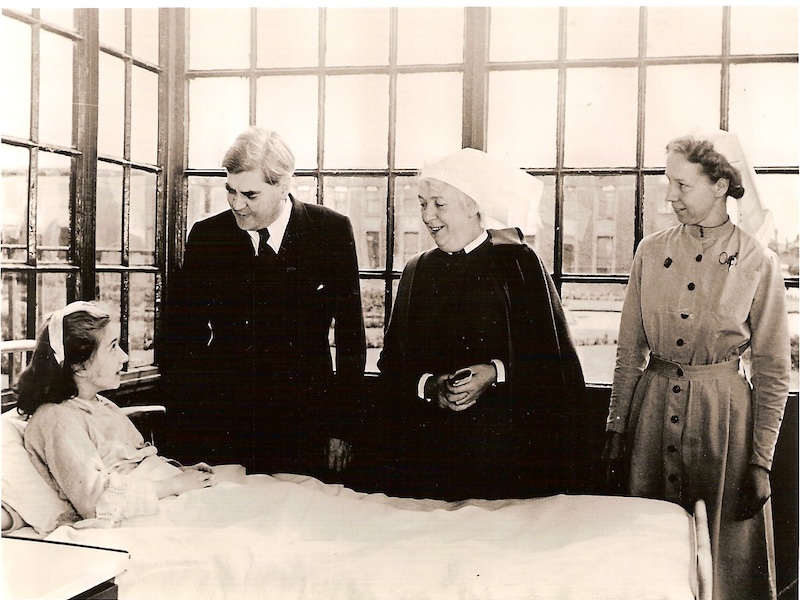
In 1948, Britain was nearly bankrupt. War debt was about twice the size of the economy, rationing was still in place, much of its infrastructure was destroyed, and the empire was falling apart. Hardly the conditions for a bold and expensive policy shift. Yet, in building the National Health Service (NHS), that’s exactly what the government chose to do.
Building a universal, free health care system would have been a huge challenge even in the best of times. But after the Second World War, Britain depended on a loan from the US just to stay solvent. With an empty treasury, the government had several priorities to fund, including reconstruction, demobilisation, and housing.
So wouldn’t it have made more sense to focus on recovery first and wait until the economy improved before creating the NHS?
The NHS reveals what can happen when the right social conditions are in place, no matter the obstacles. Its creation was one of many remarkable social and economic changes after the Second World War.
Together they led to the golden age of capitalism. Rather than a single achievement, one of the greatest achievements of the century was the conditions that made that golden age possible.
A collectivist spirit.
A spirit that changed how people in Western societies viewed the role of government. It’s the reason a country chose, at possibly the worst economic moment, to build a universal system to benefit everyone.
But that spirit didn’t last.
In its place is arguably one of the twentieth century’s worst achievements. A far more pernicious system, whose effects have led to the polarised societies of the present day, which are at risk of tearing themselves apart.
So how did this spirit form, why did it have such a positive social impact, and how did it end up giving way to something so corrosive?
Wartime collectivism
The NHS helps answer those questions.
Before 1948, National Insurance covered healthcare for working men, but not their families, the self-employed, or the unemployed. This meant most people in Britain received healthcare only if they could afford it.
Charities or local governments ran hospitals, and many lacked sufficient resources. The quality and availability of care varied widely and often depended on where you lived, with poorer areas usually getting the worst care.
No central body planned capacity or directed resources, and there was no safety net against the cost of serious illness. Those without coverage often delayed getting treatment until their problems became worse and more expensive to treat.

The war set the stage for the NHS.
Rationing and evacuations normalised state coordination in daily life. The 1942 Beveridge Report had also built cross-party appetite for a welfare state before the war even ended, and the Emergency Medical Service during the war had already partly nationalised hospitals.
So rather than a radical shift, establishing the NHS in 1948 was really just formalising a process already underway.
The Overton Window
The idea of the Overton Window helps explain why the NHS was created when it was. Named after political analyst Joseph Overton, it describes how the viability of a political idea depends on whether it falls within a window defined by the prevailing political sentiment of the time.
If a policy is outside this window, people see it as ‘radical’ or ‘unthinkable’. If it’s inside the window, it seems ‘sensible’ or ‘popular’.

The window shifts, expands, and narrows as public opinion changes. The Second World War drove a profound shift in the window as people started to expect the government to play an active role in protecting them from poverty, illness, and unemployment.
This was a major shift from classical liberalism, which shaped Britain in the 1800s and early 1900s. Classical liberalism was based on the idea that free markets are the key to prosperity, and that government usually gets in the way.
This fed a worldview: smaller government is better because the state is seen as slow and wasteful, while private businesses are seen as efficient, innovative, and productive.
Britain’s healthcare system before 1948 reflected this logic. It wasn’t the role of government to provide healthcare. If individuals couldn’t afford it, they needed to work harder and earn more.
In the collectivist atmosphere inflamed by the Second World War, this belief system suddenly felt disconnected from the human experience.
The formation of the NHS and the wider welfare state aligned with the popular sentiment of its moment. And it’s why building the NHS in a bankrupt, rationed, half-ruined Britain was considered sensible rather than economically reckless.
The Golden Age of Capitalism
The shift in the Overton Window took hold across Western Europe and the wider Global North. Keynesian economics, named after its architect, the British economist John Maynard Keynes, spearheaded this social and economic shift.
Keynes argued that aggregate demand, the total spending of households, businesses, and government combined, was the most important force driving an economy. The resulting model, a mixed economy, underpinned by market regulation and a strong welfare state, came to dominate the West.
Across Western Europe, welfare states emerged. France’s sécurité sociale in 1945, Sweden’s expanding cradle-to-grave welfare model, and West Germany’s social market economy. Each built on the same premise that the role of the state is to protect citizens from poverty, illness, and unemployment.
Trade union membership surged, and nationalisation swept through key industries, from Britain’s coal and rail to France’s Renault, shifting economic power away from private capital and toward organised labour and the state.
In the US, the GI Bill of 1944 funded education, housing, and business loans for millions of returning veterans, fuelling the growth of the American middle class. Meanwhile, Truman’s Fair Deal attempted, with only partial success, to extend New Deal-style protections into the postwar era, including a push for national health insurance that failed where Britain’s succeeded.
The decades that followed saw this collectivist energy channelled into movements demanding social rights. In the US, the Civil Rights Movement dismantled segregation, the feminist movement reshaped women’s legal and social standing across the West, and the environmental movement emerged as a new form of collective action.

Keynesian economics, and the social progress that came with it, was the crowning achievement of the twentieth century. The new balance it struck between states and markets underpinned an unprecedented period of social cohesion, stability, and prosperity across Western Europe and the Global North.
Until the mid-1970s, when it all started to come apart.
An aberration
You know who despised that collectivist spirit? The elite.
To them, capitalism was designed to benefit individuals, not society. Classical liberalism, in their eyes, was the true spirit of capitalism. Not this postwar collective spirit, which they saw as an aberration that threatened the essence of capitalism.
That’s why, in 1947, a small group of economists met at the Swiss resort of Mont Pèlerin to found what they called the ‘neoliberal agenda’. Their goal was a return to the free-market principles that had dominated before the collective spirit took hold. But as long as most people supported the collective approach, such a return was radical and unthinkable.
The neoliberals understood this. They also knew the good times wouldn’t last forever, so they quietly planned to break down the social systems created after the war. They got funding from wealthy business supporters and channelled it into academic posts, scholarships, and a growing web of free-market think tanks.
By the mid-1970s, an inflation crisis hit the economy and growth slowed, making it easier to argue against Keynesian economics. And by the late 1970s, neoliberals saw their opportunity to act.
Margaret Thatcher became Prime Minister in 1979, and Ronald Reagan became US President in 1980. Both leaders worked closely with members of the Mont Pelerin Society. Reagan’s team included over twenty members, and Thatcher’s first Chancellor, Geoffrey Howe, was also part of the group.
Together, Thatcher and Reagan stripped huge portions of economic decision-making power away from the state and from Keynesian economics, and handed it to the free market and private interests.
The neoliberal ascendancy
Since the early 1980s, popular policies have returned to liberalism’s core assumption: free markets are good, and governments are bad.
Neoliberals have driven home the idea that free markets unlock individual potential and lead to better, fairer social outcomes. They argue that free markets create an egalitarian haven where everyone has the same chance of success. They’re also meritocratic, so you get back what you put in. Markets reward productivity and punish laziness.
Since then, neoliberalism has worn away the social systems built by the collective spirit. Over time, the focus has shifted from social policies to supporting markets and individuals.
The needle has moved so far that Reform UK’s chief economic adviser has openly called for privatising the NHS, and its policy platform proposes tax relief on private healthcare and diverting funding toward private provision. Meanwhile, successive governments have already contracted out growing elements of the service to private companies.
In the golden age of capitalism, governments prioritised universal policies that aimed for the greatest good for the greatest number. Neoliberalism focuses on the greatest good for the fewest number.
It makes you wonder how the neoliberals have successfully maintained public support for nearly 50 years now.
Well, individualism serves the elite by atomising society. But it’s their use of polarisation that is the cruellest element of their agenda.
For decades, a set of policies that clearly benefits a minority has been voted for by the majority because different groups have been manipulated into believing that other groups, not the economic system itself, cause their problems.
Social media has weaponised this process of intentional division, inflaming resentment by isolating groups in echo chambers that reinforce the idea that other groups are the problem. The argument being, if we could get rid of THEM, well, all of our problems would disappear.
Sure, they would.
Polarisation is a breeding ground for extremism and helps explain the increased popularity of the far-right that has fused neoliberal assumptions with a nationalist, anti-establishment agenda. The underlying worldview has become so deeply embedded that these extremist views don’t seem radical; to many, they appear sensible.
Do you remember how this story began?
With a wholesome photo of a government minister with a sick child in a hospital bed, on the first day of a service based on the idea that caring for her was society’s responsibility, not just her own. For a short time, this was the widely accepted view in the West, and society flourished as a result.
That image has become completely out of touch with our current reality.
That’s the quiet tragedy underneath this story. Neoliberals are fully aware that a united society is unlikely to agree to policies that serve a minority. So they intentionally divided society to serve their own interests.
But you can only tear society apart for so long. This state of affairs can’t, and won’t, continue indefinitely. The question worth sitting with is: if people have only come together in the past during a shared crisis, can we rebuild that sense of unity without another crisis? That’s a troubling thought to consider.