

How a simplifying model of humanity became a blueprint for society
Humans can be loving and cruel, generous and selfish, rational and impulsive — sometimes all in the same afternoon. That complexity is part of what makes us human. It’s also a nightmare if you’re trying to define ‘human nature’.
Human nature refers to our natural dispositions. It’s about how we think, feel and act — and these characteristics are shared by all humans. What we believe about human nature matters because ideas about it influence laws, institutions, social norms and ultimately, how we see ourselves.
Few disciplines have shaped those beliefs more powerfully than economics. Economists build models, stories if you like, to explain how the economy works. But you can’t build a coherent story around a character who is emotional, contradictory and unpredictable.
To overcome that unpredictability, economists have embraced a simplifying strategy—ignore the parts of humanity that don’t fit those models, and amplify the parts that do.
Economics did not set out to define human nature in its entirety. It selected a narrow version of it — one that “worked” within its models — and built a system around that version.
We are self-interested
One of the core assumptions of economics is that humans are fundamentally self-interested.
In The Wealth of Nations, written in 1776, Adam Smith argued that every person prioritises their self-interest. The fact that each person makes decisions for their personal gain is a good thing because when each person follows their self-interest, the “invisible hand” of the market transforms private motives into public benefits.
If individuals reliably pursue their own advantage, then markets become self-regulating systems. The pursuit of profit becomes socially productive. Regulation begins to look unnecessary, even harmful, because interference could distort the natural alignment between private interest and public good.
We thrive in competition
Smith’s argument was later reinforced by the cultural impact of On the Origin of Species. Published in 1859, Darwin’s theory of evolution by natural selection described how organisms better adapted to their environment are more likely to survive and reproduce.
Darwin was writing about biology, not morality or economics. But social and economic thinking absorbed his language of adaptation, competition and selection.
The phrase “survival of the fittest” was coined by Herbert Spencer in Principles of Biology to describe how animals most suited to their environment have the best chance of survival.
But the term was misappropriated and became shorthand for a broader social belief: that competition is natural, inequality is inevitable, and those who succeed do so because they are inherently more capable.
By framing competition as natural, markets could be presented not as a political design but as a reflection of natural systems. In this translation from biology to society, natural selection was recast as market selection, helping to establish a belief that markets create a meritocratic system in which everyone has an equal chance to succeed.
Economic winners in such a system aren’t fortunate or structurally advantaged, but are the “fittest.” Poverty isn’t a sign of systemic failure, but more evidence of individual inadequacy.
While they are not conscious, free markets are said to be moral because they fairly and rationally reward good behaviour and punish bad behaviour.
If economic theory justified self-interest as productive, evolutionary language appeared to legitimise competition as unavoidable. Together, they helped entrench a powerful idea: that systems built on rivalry and individual advantage are not political choices, but reflections of nature itself.
We are greedy and never satisfied
Self-interest may strengthen the argument for free markets, but not for the underlying goal of economic growth.
For expansion to be continuous, desire must be continuous.
In the 1830s, John Stuart Mill described “economic man” as motivated by the desire for wealth. Accompanying that motivation is a dislike of work and a love of luxuries; essentially, humans are hedonists who aim to maximise pleasure and minimise pain.
Mill argued that these motivators influence the structure of the economic system. For example, property law is an institution that allows people to accumulate wealth.
In the 1870s, William Jevons argued that humans are pleasure-seekers who exist to maximise utility (defined as the satisfaction derived from consuming goods).
Jevons drew on the psychological principle of satiation to create a law of diminishing returns, arguing that the more you have of something, the less you’ll want more of it. However, this does not diminish your overall appetite to consume; only the consumption of a particular product.
The assumption that human desire is endless justifies the goal of economic growth and endless expansion. When it’s assumed that happiness increases with more, then a system of growth aligns with human nature. A steady-state economy would seem neither stable nor stable, but stifling, because it would frustrate our presumed instinct to accumulate.
Based on these assumptions, growth is not a policy choice, but a psychological necessity.
Within this framework, free-market capitalism is not simply one system among many — it is the system most compatible with ever-expanding preferences. Deregulated markets facilitate accumulation, innovation and consumption at scale. Endless desire, therefore, justifies endless expansion.
We are rational
In the twentieth century, man evolved into his modern form, the ‘rational economic man’, also known as ‘Homo economicus’ or ‘economic man’.
The rational economic man is self-interested. He seeks to maximise utility. But crucially, he does so rationally, meaning choices are logically consistent and uninfluenced by emotion or bias because he has perfect information, where he has complete knowledge of choices, costs, and future outcomes.
The issue is not simply that humans are imperfectly rational. It is that rationality came to be defined narrowly — as efficiency in satisfying preferences.
Rationality did not mean wisdom, moral judgment or collective flourishing. It meant optimisation.
If individuals are rational utility maximisers, then markets become the ultimate coordinating mechanism. Each person pursuing their own interests in a logical, consistent way contributes to efficient outcomes. Government intervention appears unnecessary unless correcting clear market failures.
Again, the conception of human nature strengthens the intellectual case for free-market capitalism and weakens arguments for regulation. If individuals can calculate what is best for themselves, markets can aggregate those choices more effectively than any central authority.
We are destroying the conditions for life
The character at the centre of the economic story is selfish, insatiable and devoid of emotion. When those assumptions are embedded in economic theory, they become institutionalised — in law, markets, incentives and cultural norms.
The extreme simplifying strategy embraced by economists strips humanity down to what can be measured, priced and optimised. It ignores the arts and culture —the things that bring people joy—it strips away all aspects of life that bring wonder and inspiration.
Activities that cannot be easily priced — caregiving, ecological preservation, artistic creation — become economically invisible.
Not only that, but if rational individuals produce a rational system, why do carbon emissions continue to increase, threatening the conditions for life itself? This is only reinforced by the fact that carbon emissions, the greatest market failure of all time, are not baked into prices through a carbon tax, which could work to limit the failure.
But then, that would be disastrous for vested interests like oil companies and their shareholders.
We have designed society to serve an economy based on flawed assumptions about human nature. The traits rewarded within that system are those the model assumed in the first place: self-interest, accumulation, competition, and relentless expansion.
It sure doesn’t feel like we’ve created an economy designed to enhance happiness. If anything, the result is a dysfunctional, environmentally destructive society that is eating itself alive. If what we’ve built is the logical outcome of our assumptions about human nature, then the flaw is not in humanity itself, but the stories we have been taught to believe.

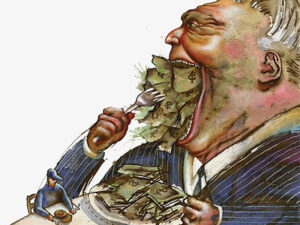
I see it as a feedback loop. Our capitalist society was designed around one small part of human nature, that becomes amplified and feeds back into society, demanding more competitiveness, more selfishness, until we reach the current hyper-individualist late stage capitalism we know and love(!)
Many perfectly intelligent people will claim in discussion that capitalism is just natural because humans are competitive, they’ll quote ‘survival of the fittest’ like you said, but the only humans they know grew up in a capitalist society, one which forces competitiveness on you whether you like it or not. They seem unaware of the circular nature of their argument. But unless we break that loop we (and most complex life on Earth) are done for.