
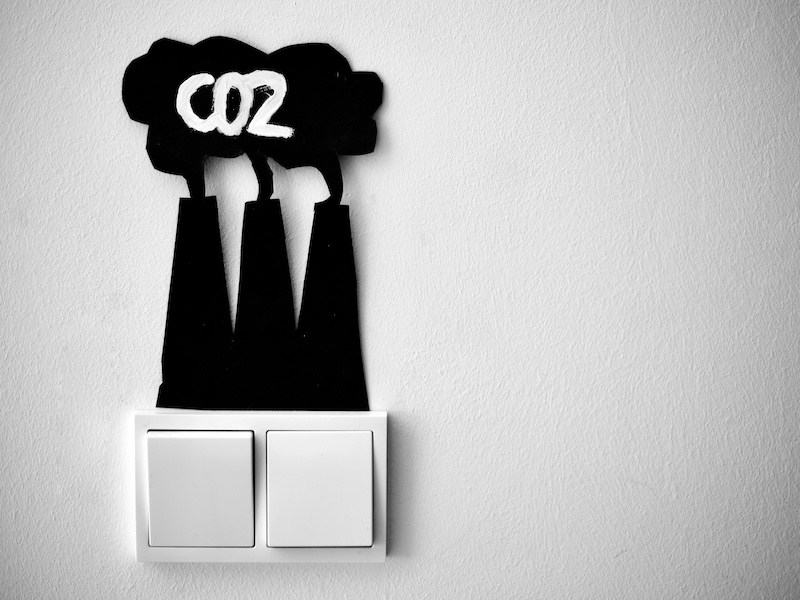
Imagine being faced with a challenge so complicated that no one dares ask the question that might lead to solutions because the consequences of doing so don’t bear contemplating. That’s the problem we’re facing with the climate crisis. It’s unthinkable that emissions continue to rise, as it will lead to climate breakdown. But it’s also unthinkable to question why emissions continue to rise, because it will lead to social breakdown. We’re stuck between a planetary-scale rock and a hard place.
The result?
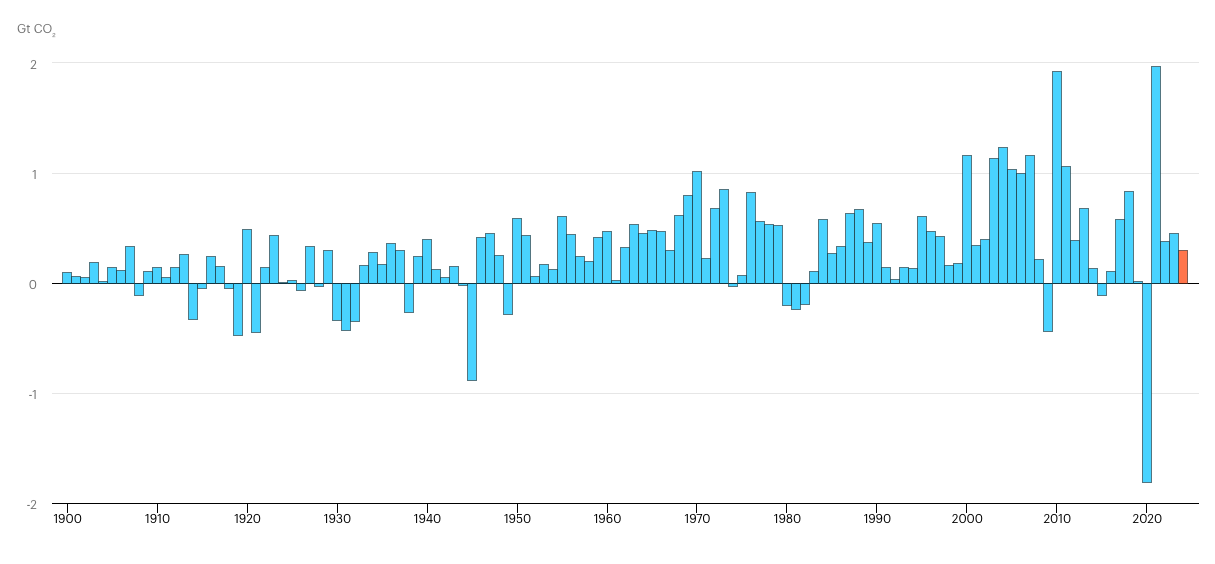
Carbon Dioxide (CO2) emissions reached an all-time high in 2025. In fact, the graph of annual CO2 emissions from 1900 to 2024 shows that, since 1950, emissions have increased sharply, except for a few anomalies, most notably in 2008 and 2020.
If emissions must reduce dramatically to avoid climate breakdown, why do they continue to rise? And, more importantly, if we question why they’re rising, why would that lead to social breakdown?
The SCQA framework can help us unravel the riddle.
The SCQA Framework
Barnard Minto’s SCQA (Situation, Complication, Question, Answer) framework is an effective method for conveying complex information to an audience and helping groups reach an agreement on a question. That’s pretty critical in finding solutions, to well, anything. It becomes even more important when dealing with a crisis requiring coordinated global consensus.
Minto splits the SCQA framework into two parts: asking the question and then answering it.
To ask the right question, you first need to define the situation — the core problem — and the complication, which explains why it’s vital to act now. Together, these shape the question: how can the obstacles raised by the complication be overcome?
The answer should then directly address that question and provide a path to a solution.
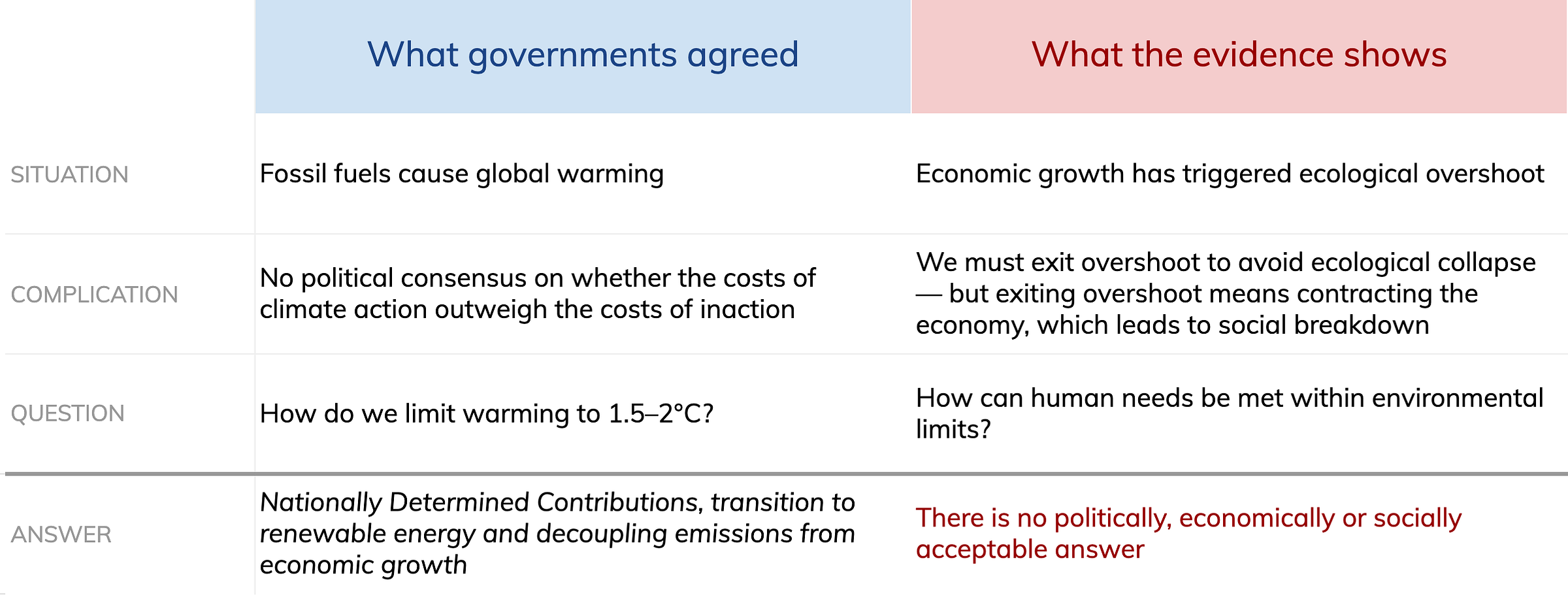
When it comes to climate change, there is broad agreement on the situation— carbon emissions from fossil fuels are leading to global warming.
But the problems start with the complication, because no one agrees on it. For some, it’s vital to reduce emissions now because global warming will have devastating impacts that lead to enormous economic costs. For others, it’s vital that we continue to burn fossil fuels while dismissing the impacts of climate change as overblown because climate policy threatens economic prosperity.
Parties on the right tend to support the latter view, exemplified by the Trump slogan ‘drill, baby, drill’.
The complication means that to be politically viable, any solution to the climate crisis must not undermine the economy or living standards.
That’s why we ended up landing on the question that governments have widely agreed upon through the Paris Agreement, namely:
‘How do we limit global warming to well below 2°C while making efforts to limit warming to 1.5 °C?’
The answer is focused on governments developing commitments through Nationally Determined Contributions (NDCs) — essentially a country’s climate action plan to cut greenhouse gas emissions.
Currently, most countries’ plans fall critically short of what’s required, with current pledges putting the world on track for an average temperature rise of 2.3°C to 2.5°C by the end of the century.
And that’s assuming plans are fully implemented.
Eleven years since the Paris Agreement, the fact that emissions continue to rise suggests the approach isn’t working, so what’s the problem?
We’re asking the entirely wrong question — because the situation and complication have been ill-defined — and that’s where the current approach begins to unravel.
Digging deeper
The situation is far more complicated than governments have been willing to acknowledge.
Ever since the Industrial Revolution, rising production has led to an explosion in living standards. But sustaining increases in production requires ever-increasing energy inputs. Today, 80% of our energy inputs come from fossil fuels.
So the situation isn’t so much that carbon emissions are causing global warming. It’s that emissions result from sustaining high and rising living standards, facilitated by increased production and consumption.
The situation is complicated by a core belief of capitalism — the more we consume, the higher our living standards and therefore the happier we’ll be. So the economic goal of every country is to pursue economic growth, because growth leads to more wealth, higher incomes, and a greater capacity to consume.
An additional complication is that living standards aren’t on a level playing field. For example, over 800 million people, or 10% of the global population, earn less than $3 a day. Ending poverty requires expanding economic activity by increasing both production and consumption, thereby raising living standards.
That can’t be done without increasing energy inputs. This situation and complication lead to a very different question.
How can rising living standards be maintained while reducing global emissions?
The myth of decoupling
The answer lies in decoupling emissions from economic activity by making products and services more energy-efficient. So you get the same outputs, but in a less energy-intensive way.
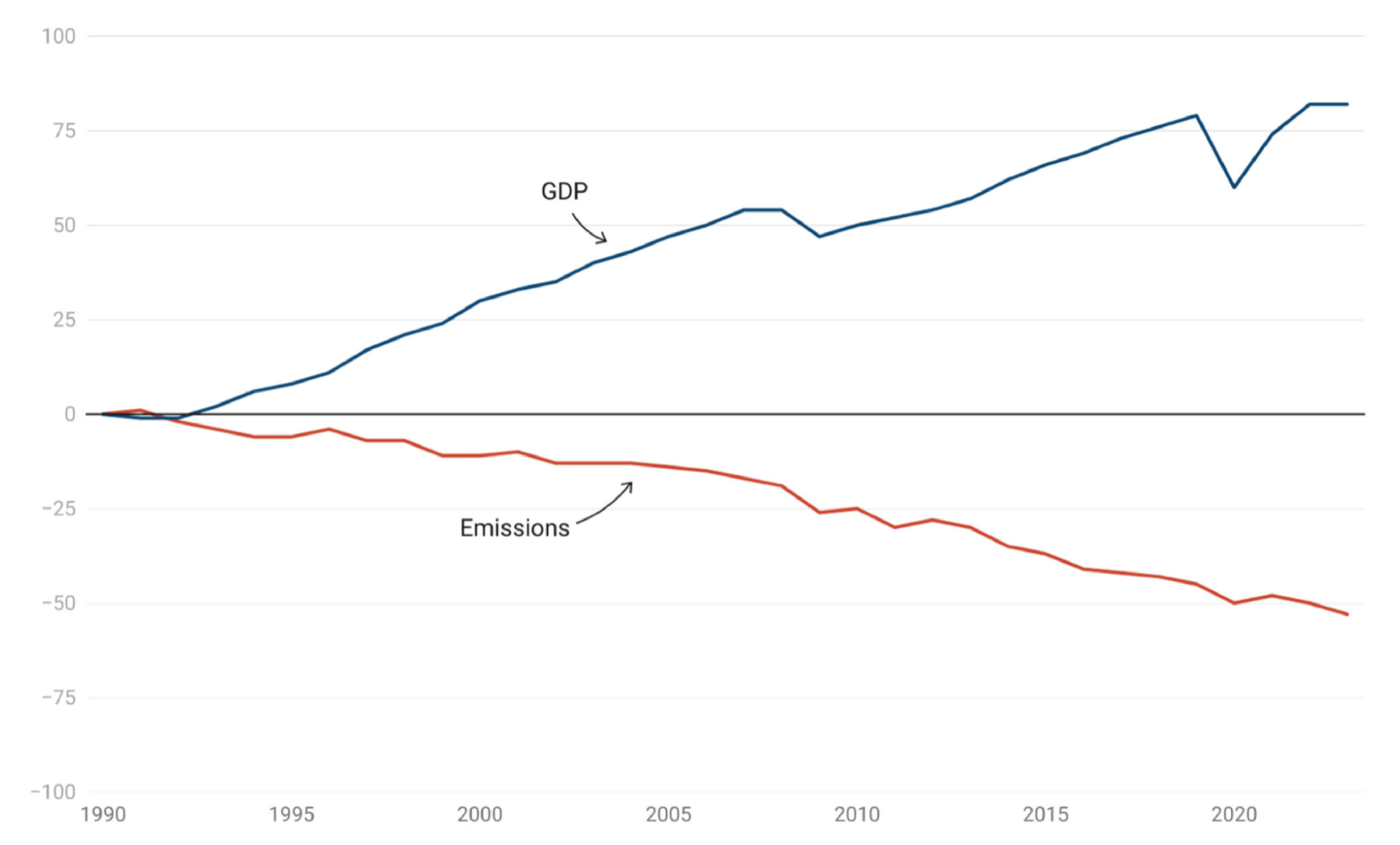
Since 1990, UK emissions have fallen by 53%, while the economy has grown 82%. So how did the UK do it?
Manufacturing is — by far — the most energy-intensive sector, consuming around 40% of global energy supply. Services consume around 9% of global energy supply because their energy footprint is largely limited to powering and heating office spaces, data centres, and employee transport, with most of their energy coming from electricity.
In 1990, manufacturing accounted for around 16.5% of the UK’s Gross Domestic Product (GDP), and services accounted for 70%. In contrast, manufacturing now accounts for 8.5% of total economic output, while services account for 80%.
Factor in renewables, which now account for 52% of UK electricity generation compared to around 2% in 1990, and it’s clear how emissions have been decoupled from economic growth. The UK economy is dominated by services and is fed by an electricity system that is increasingly renewable.
On the surface, the UK is a model example for other countries to follow. But delve deeper, and the graph illustrates arguably the greatest challenge in addressing rising emissions.
In 2024, the UK imported £527.3 billion worth of manufactured goods, accounting for 88% of its total goods imports. When it did so, it did not internalise the emissions generated by those imported goods; they were accounted for by the country that produced them.
The graph distorts reality.
Emissions have not been decoupled from economic activity; they’ve just been exported to producers of products, rather than to the consumers of those products in high-income nations.
Distorted realities play a vital role in how climate change mitigation is communicated. There is no need to question lifestyles because technological efficiencies and a shift to renewable energy can sustain growth while reducing emissions. The underlying assumption is that it is possible to maintain high and rising living standards while reducing emissions.
The root cause
Those anomalies in 2009 and 2020 expose the assumption for what it is — a convenient fiction. In 2009, the global economy contracted by 1.8% following the 2008 financial crisis. In 2020, the global economy contracted by approximately 3.3% to 3.4% due to the COVID-19 pandemic.
These years are significant because economic growth occurs by increasing production. This requires increasing inputs of energy and resources. The more we produce, the more energy we need.
Emissions increase because of economic growth. Emissions decrease only when the economy contracts, which is socially, economically and politically terrible news.
But emissions are just one symptom of a deeper problem.
More people consuming more stuff leads to an increase in our collective ‘ecological footprint’ — the rate we consume resources and generate waste compared to how fast nature can absorb waste and replenish resources.
The Global Footprint Network uses the ecological footprint to measure how quickly humanity consumes resources compared to how quickly nature can replenish them. Since 1971, we’ve been in a state of ecological overshoot — meaning our ecological footprint is greater than what one planet Earth can sustain.
Today, we need 1.75 Earths to maintain our current lifestyles.
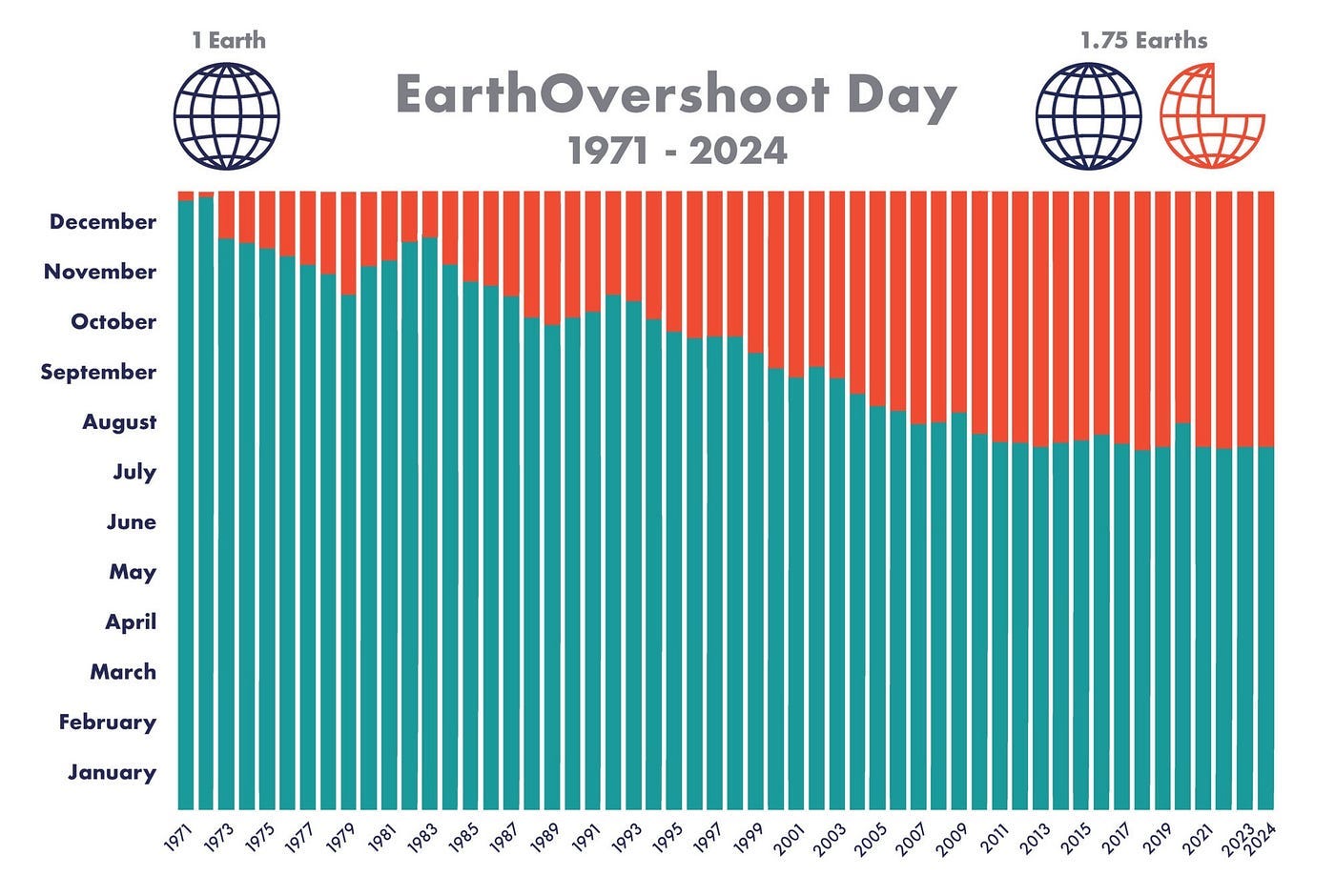
Overshoot is why we’re facing a climate crisis — and it creates a rather different situation. Economic growth has triggered ecological overshoot; to avoid a catastrophic future, we must exit it.
This is the fundamental premise of post-growth economics. Exiting overshoot requires shifting away from growth as the organising principle of society and towards meeting human needs within planetary limits.
The complication is that we have designed society to serve economic growth. Economic growth is so important to society that if it’s not maintained, it will lead to recession, depression, and eventual collapse — and it remains the primary mechanism through which billions of people hope to escape poverty.
The question that must be asked to avoid environmental breakdown — How can human needs be met within environmental limits? — is the question that can’t be asked to avoid social breakdown.
Politically, socially and economically, the short-term benefits of sustaining growth far outweigh the perceived future risks of overshoot. While the latter may have devastating impacts down the line, questioning the former would trigger social collapse now.
Better not to ask the question, then, and to continue pursuing a course of action that doesn’t work.
Economies will continue to pursue growth. Overshoot will accelerate. Emissions will continue to rise.
The question that must be asked will remain the one that can’t be asked until the impacts of overshoot become so severe that growth becomes impossible to sustain.
That is the bitter irony at the heart of this crisis. The reality of overshoot means the social breakdown that politicians and economists work so hard to avoid is unavoidable. The only real question is whether it arrives on our terms or nature’s.
If it arrives on nature’s terms — through ecological collapse, crop failure, displacement, and economic unravelling — the window for building something better will be narrow and the human cost enormous. It could still arrive on our terms — but only if we find the collective will to ask the question no society has yet been willing to ask.