

Social media rewards sensationalism, buries nuance, and manufactures false expertise
Social media platforms have evolved to reward intolerance. Algorithms engineered to maximise engagement empower nationalists, racists, and sexists to build large audiences by constructing echo chambers. These algorithms incentivise uncompromising, polarised perspectives over nuanced debate, fueling a divisive ‘us versus them’ mindset; that ‘we’re right, they’re wrong’. We’re witnessing the devastating consequences play out in real time.
Nowhere are the impacts more visible than in the US, where political polarisation, religious hostility, and anti-immigrant sentiment risk tearing America apart.
In hindsight, in an age of information overload, increased intolerance was perhaps inevitable. Billions of social media posts are created every single day.
With so much information, sensationalist content is driven to the forefront, gaining the most engagement. This crowds out nuanced discussion and allows false experts to become more influential than true experts, who are lost in the noise. The mechanics of visibility favour intolerance and extremes.
The erosion of nuance
Information overload explains why real experts are increasingly feeling the pull of sensationalism. Take a 2014 journal article titled, ‘Female hurricanes are deadlier than male hurricanes’. That’s an interesting headline. We know hurricanes are storms that don’t have a gender. So how can ‘female’ hurricanes kill more than ‘male’ ones?
Compelling headlines attract attention; the danger is that most people only engage with headlines, not the articles. For example, 75% of articles shared on Facebook were not actually read before being shared.
In this environment, imagine someone sees that headline about hurricanes. They make a misconception based on stereotypes and share it with friends and family, who are likely to do the same.
And boom!
Suddenly, an authoritative source has worked to reinforce sexist, intolerant misconceptions.
If anyone bothered to read the content, they would find that the reason ‘female’ hurricanes are deadlier is historical rather than gendered. Before 1979, hurricanes were given only female names, and far more people died in storms because building standards were weaker.
Adding this missing nuance completely changes our understanding and highlights the issue seen elsewhere: when complexity gets crowded out, the consequences extend far beyond a single misleading headline.
A more accurate headline would be “Fewer people have died from hurricanes after 1979 due to better building practices.” People are far more likely to ignore an article about better building standards because it sounds dull and doesn’t conjure the same intrigue or trigger the same kind of emotional reaction.
The Dunning-Kruger effect
In a world overloaded with information and headline-driven engagement, nuance loses importance. This environment benefits false experts and fuels intolerance, since surface-level engagement is mistaken for expertise, and entrenched opinions flourish.
The Dunning-Kruger effect reveals the problem. Someone who has read a few headlines and gets lost in an echo chamber knows very little about a topic, but repeated exposure to similar arguments creates the illusion of understanding, maybe even expertise.
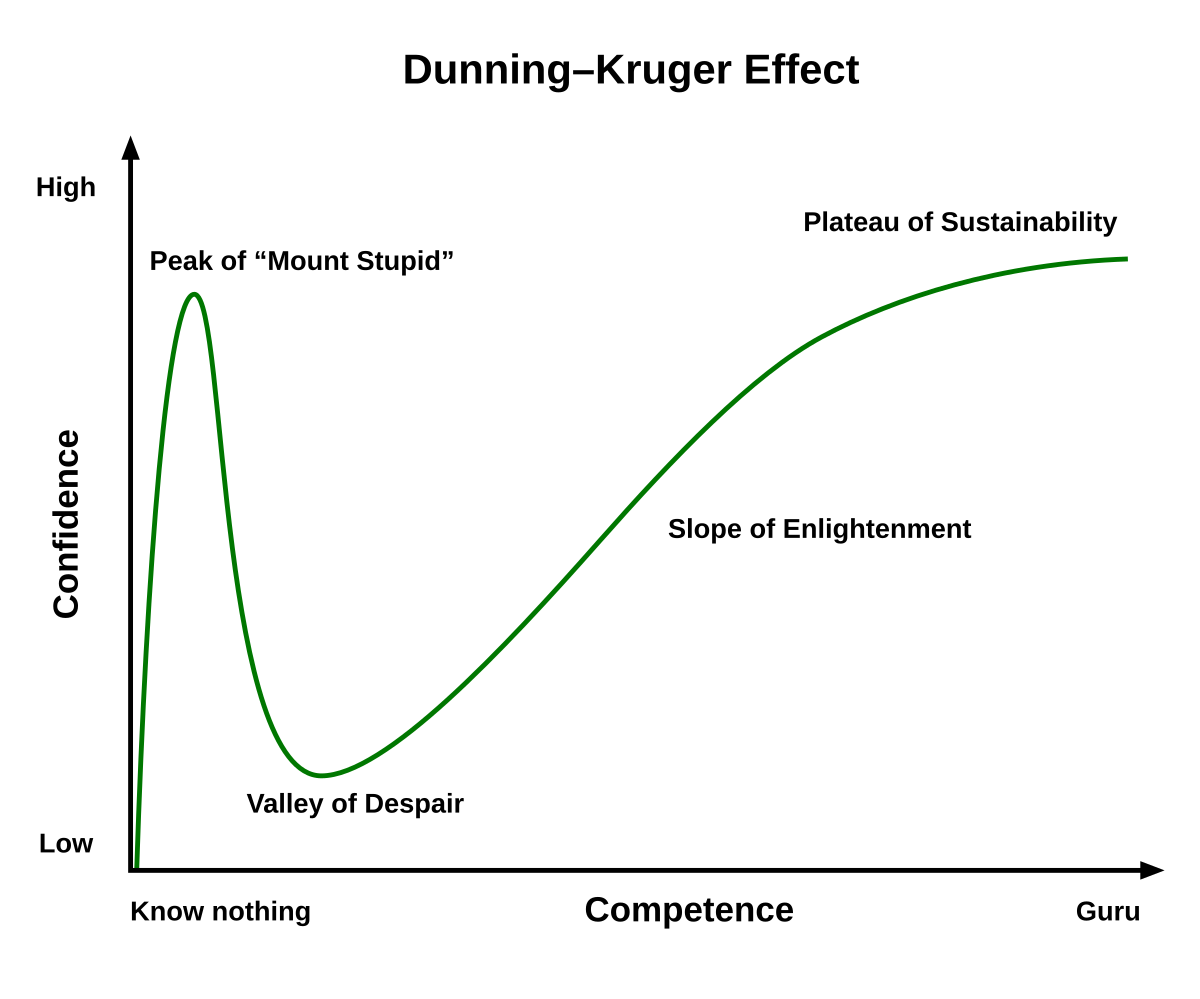
Little to no competence can produce high confidence because the would-be expert has no awareness of how much there is to know. This is Mt. Stupid: a place where people who speak with certainty on social media are rewarded with attention and are treated as authorities, which only strengthens their delusional confidence in their expertise.
No need to support the argument with, say, evidence; just make a controversial argument that feeds an echo chamber, and the converted will believe it.
It’s only when someone has a commitment to becoming an expert that they descend Mt. Stupid and fall into the valley of despair. They gain an appreciation of how much there is to know about a subject and how little they know.
This leads to confidence nosediving.
It’s here where the long road to entitlement begins. The more they know, the greater their confidence in the subject, until eventually, competence and confidence align, and the person becomes an expert.
That appears to be the exact point where people start to ignore what experts say. Hence, why academics are tempted to use clickbait titles that do their research a disservice.
We’re trapped within a dangerous loop of misinformation, where those who do get engagement tend to be sensationalists standing confidently atop Mt. Stupid.
Tearing society apart
Social media has created invisible information silos. People consume information within these silos as absolute truth, reinforcing polarisation and fostering dangerous certainty. This system underpins the rise of modern intolerance.
And when people believe that the news they read is the truth rather than opinions or interpretations, then we have ourselves a giant problem.
A United States of America size of a problem.
This situation is only getting worse because 55% of Americans now rely on social media for their news.
Social media has become an unregulated swamp. The UK government is taking steps to regulate social media platforms, establishing safety mechanisms and stronger content moderation to monitor the sources of information people view. This is a step in the right direction, but what’s desperately required is adequate global regulation.
Given there’s no institution to regulate the internet, it seems unlikely that one will emerge anytime soon. And so, echo chambers will strengthen, and intolerance will fester and grow. In the US, the damage appears terminal; all the country needs is the slightest of nudges, and the threads that are barely holding society together will tear apart altogether.