
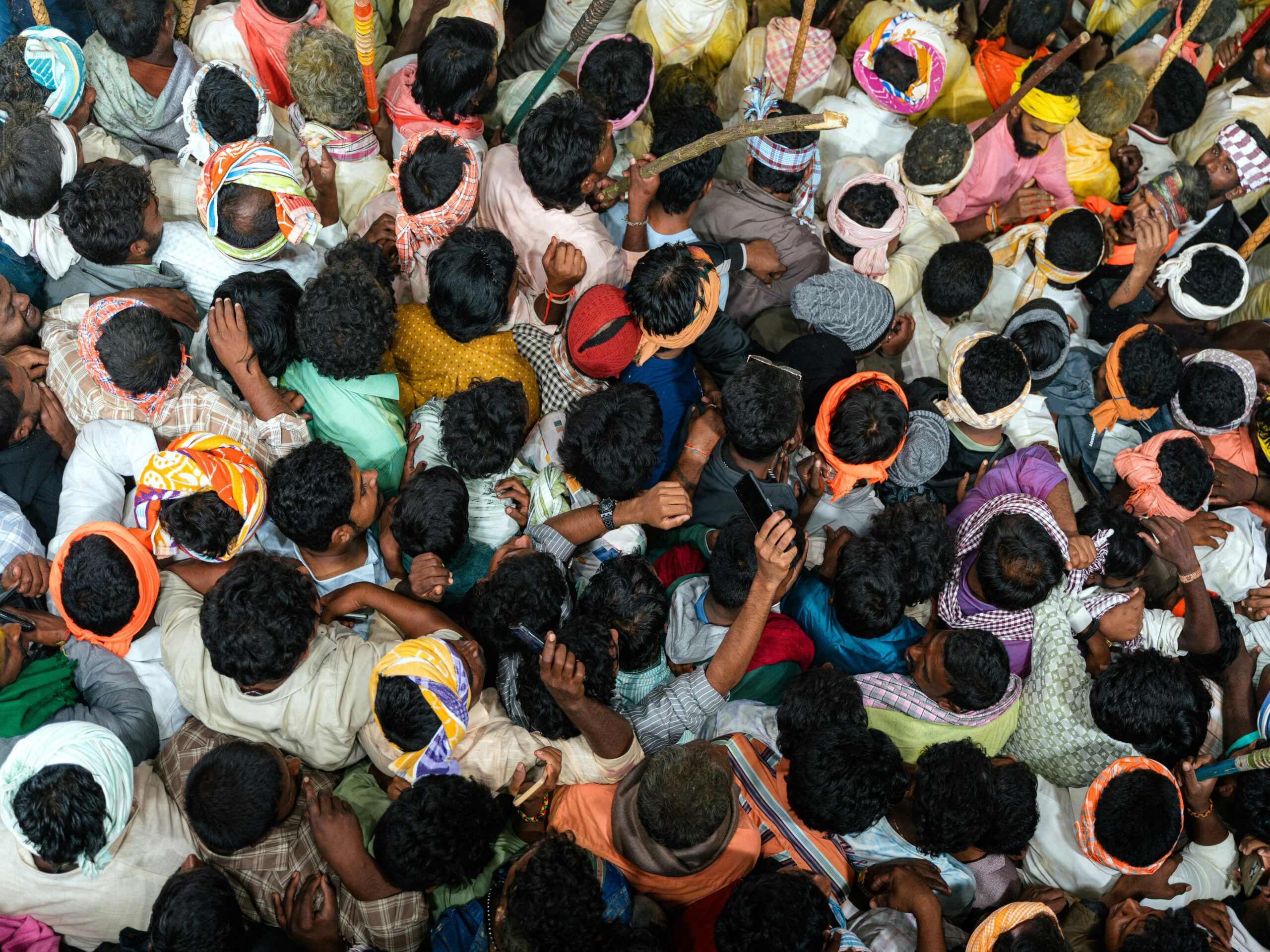
The global population is growing by around 70 to 80 million people a year, placing enormous pressure on the natural systems that sustain life. The obvious solution is to reduce the birth rate. And we know exactly how to do it. End poverty by stimulating economic growth and living standards rise while birth rates fall. It has worked every single time.
But economic growth solves the problem by creating two new ones.
First, growth-driven consumption is the primary driver of ecological overshoot — a situation where humanity’s demands on the natural world exceed what the planet can sustain. If each person ends up consuming far more, then a declining population doesn’t fix this; it makes it worse.
Second, the same rise in living standards that reduces birth rates also undermines the demographic conditions that enable modern economies to function. When birth rates fall too far, the working-age population shrinks relative to the retired population, leaving pension systems built to support the elderly increasingly unaffordable.
Economic growth is not a development path with some unfortunate side effects. It’s a development path that ends poverty in ways that are ecologically unsustainable and demographically unstable. The solution in a growth economy is always the same — more growth. It tries to resolve the problem by making the problem worse.
So what’s the solution?
Damned if the population rises
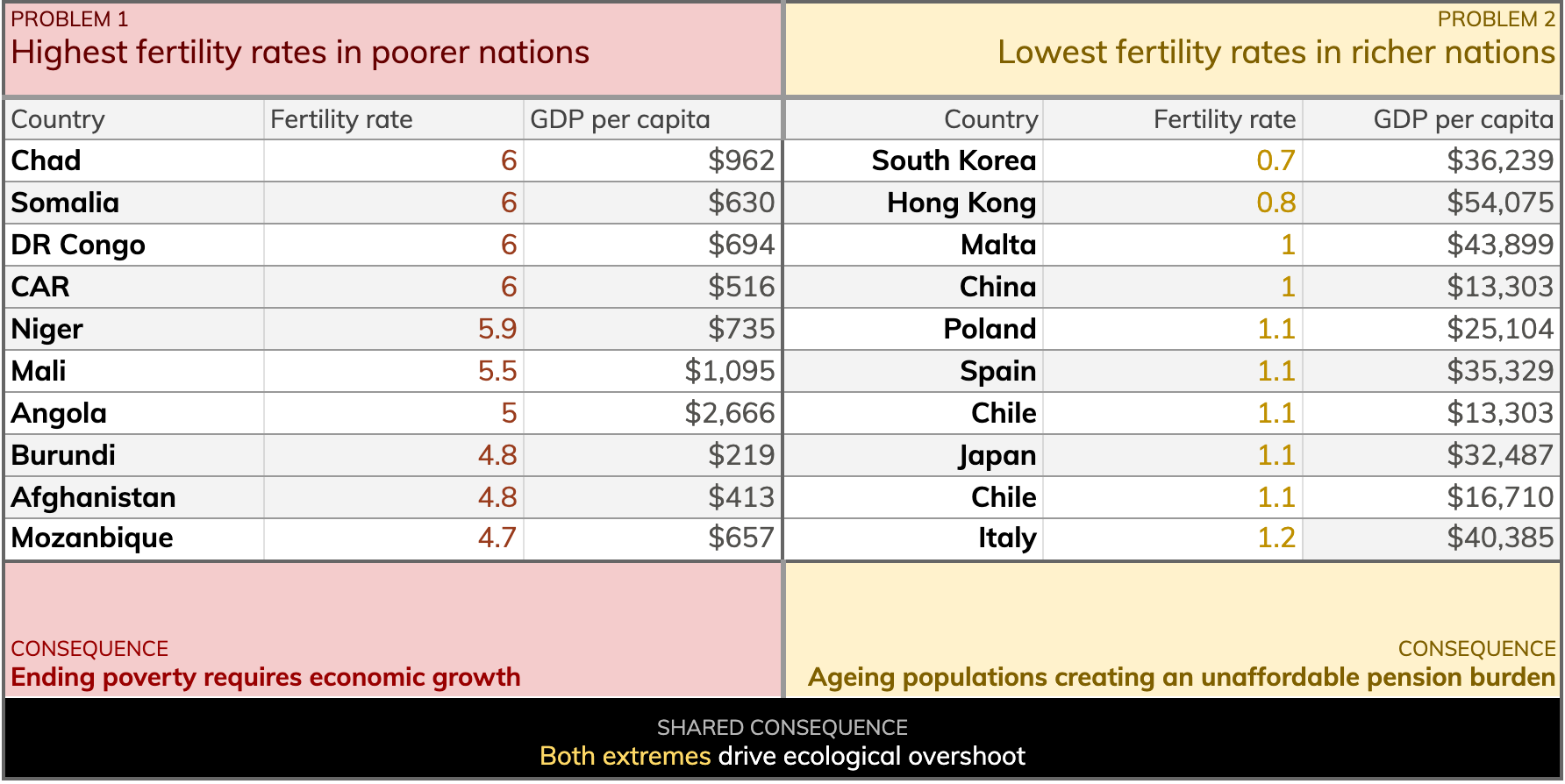
The reasons countries with the highest birth rates are among the world’s poorest are structural. Without access to contraception, with high infant mortality, and with women locked out of education and formal work, children become both an economic necessity and a form of social security for parents too old to work.
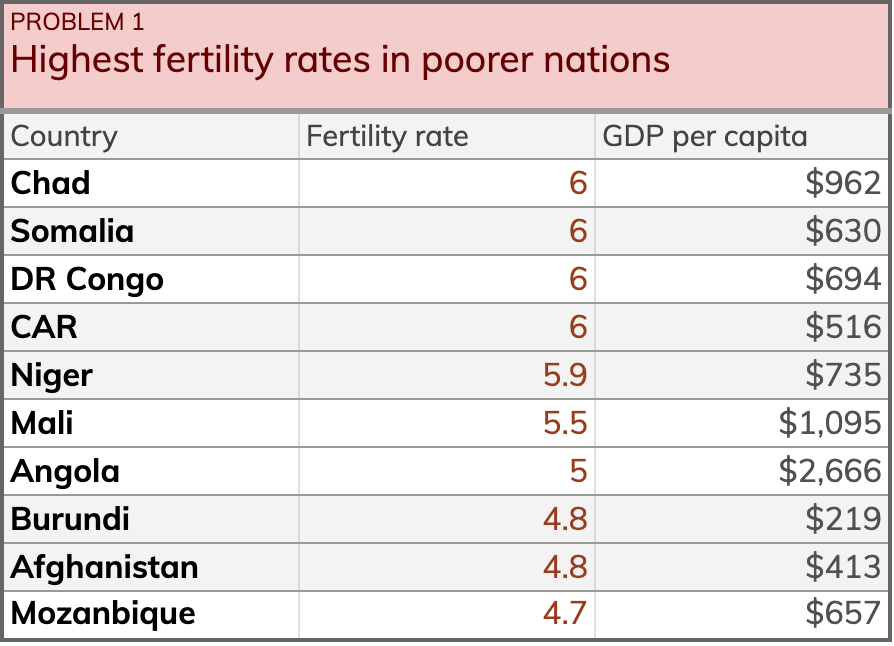
A population grows when the birth rate exceeds the replacement rate of 2.1. This is the average number of children every woman needs to have to maintain the same population.
Population growth is concentrated in low-income nations, particularly in Sub-Saharan Africa, where the average fertility rate is around 4.2 children per woman.
So why is a growing population so problematic?
Driving ecological overshoot
Each person’s needs are supported by the natural world. The bigger the population, the greater our overall needs and the more pressure we place on the natural world to deliver them. More people consuming more stuff leads to an increase in our collective ‘ecological footprint’ — the rate we consume resources and generate waste compared to how fast nature can absorb waste and replenish resources.
The Global Footprint Network uses the ecological footprint to measure how quickly humanity consumes resources compared to how quickly nature can replenish them. Since 1971, we’ve been in a state of ecological overshoot — meaning our ecological footprint is greater than what one planet Earth can sustain. Today, we need 1.75 Earths to maintain our current lifestyles.
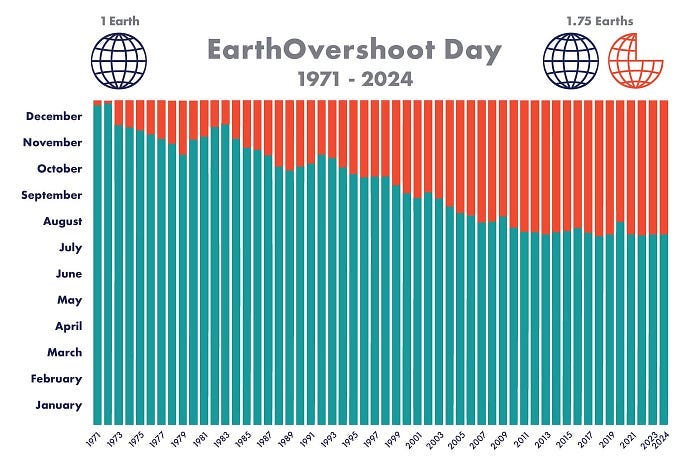
A growing population makes overshoot worse.
But so does economic growth, because growth leads to increasing production and consumption.
While this leads to higher living standards and a falling population, a smaller population consuming much more actually accelerates overshoot. If everyone lived like people in the US, for example, we would need 5.1 Earths to maintain that lifestyle. If we all lived like the French or Spanish, we would need 2.8 Earths.
This means the very tool we use to reduce birth rates is also deepening the ecological crisis we’re trying to escape.
But the problems with growth don’t end there. South Korea perhaps best illustrates the demographic problems growth creates.
The miracle of the Han River
In the mid-1950s, South Korea was one of the poorest countries in the world — 40% of the population lived in absolute poverty, the economy was dominated by agriculture, and the fertility rate stood at 6.3 births per woman.
Rapid industrialisation after the Korean War triggered an economic transformation. During the 1960s and 1970s, South Korea’s economy grew at an average annual rate of roughly 10%, transforming the war-torn agrarian nation into a formidable industrial powerhouse.
Today, South Korea has one of the most technologically advanced economies in the world and the 15th-largest by Gross Domestic Product.
Rising living costs, expanding female education, delayed marriages, and shifting cultural attitudes toward family size have reshaped how South Koreans live.
The fertility rate has fallen to 0.7— the lowest in the world.
Damned if the population falls
South Korea’s fertility rate has fallen so far that the average age of society is rising sharply. Over 19% of South Koreans are already over 65, and nearly 20% of the working-age population is 55 or older.
As more people reach pensionable age and fewer enter the workforce, tax revenues shrink while pension costs grow. South Korea’s pension fund is forecast to run dry by 2069 — an economic catastrophe in slow motion that would leave the country bankrupt.
South Korea is the most extreme case, but far from the only one. Japan, China, Italy, and Germany are all facing similar challenges — with shrinking workforces, ageing populations, and pension systems under mounting strain.
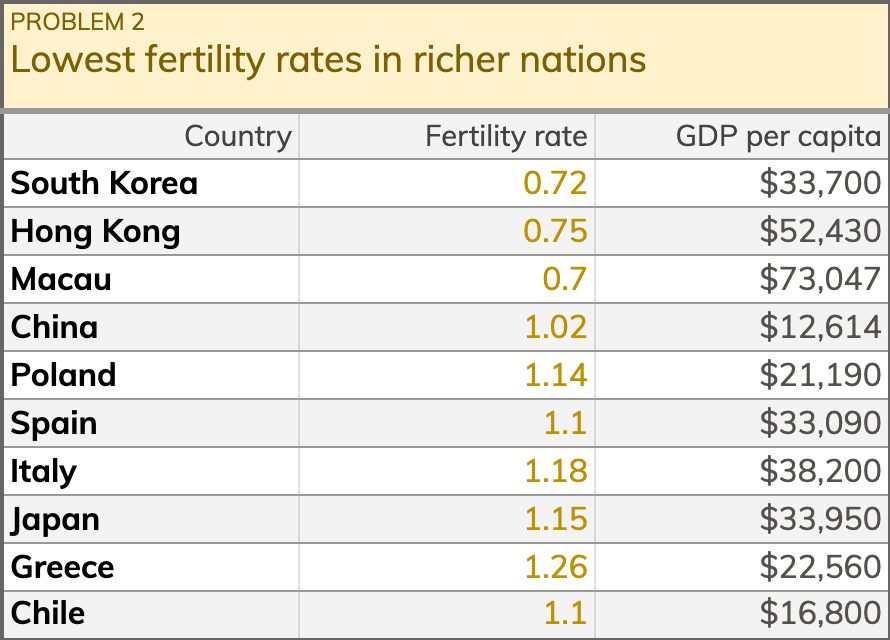
This is the trap economic growth creates. It raises living standards, which reduces birth rates, but if birth rates fall too far below the replacement rate, it destabilises the demographic balance that modern economies depend on.
No way out
Doughnut Economics makes the full scale of the trap visible. The model sets two boundaries: a social foundation defining the minimum people need to live a fulfilling life — food, water, energy, housing, healthcare — and an ecological ceiling comprising nine planetary boundaries essential to a healthy natural world. Breaching a boundary risks destabilising the systems that sustain life.
Achieving a sustainable society involves meeting human needs without exceeding the ecological limits defined by planetary boundaries. Yet the truth it, no country currently manages it.
In the Global North, living standards are high and social foundations largely met — but every planetary boundary is being breached, because high living standards are built on consumption.
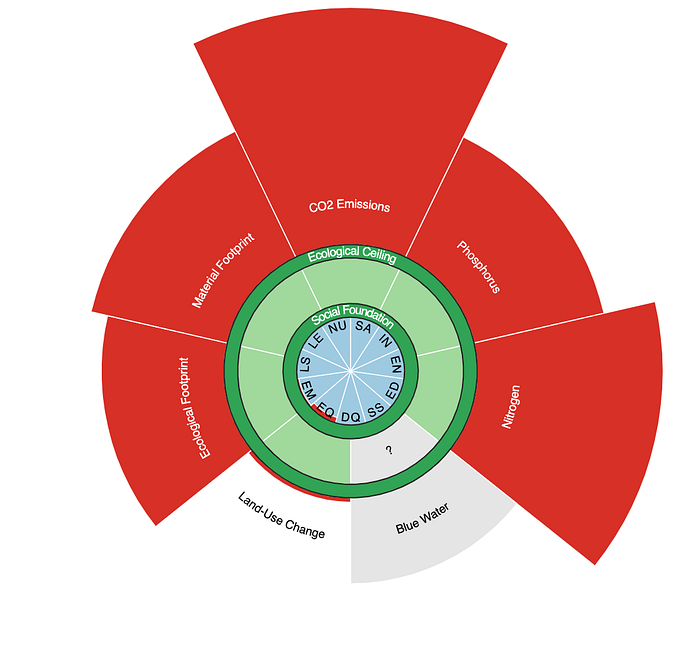
Rich nations may look relatively successful socially, but they are structurally unsustainable.
In the Global South, the picture is starker still. Countries like India, Nigeria, and Indonesia consume far less — yet still overshoot multiple environmental boundaries, while failing to meet basic social needs. They are degrading ecosystems and still fail to lift people out of poverty.
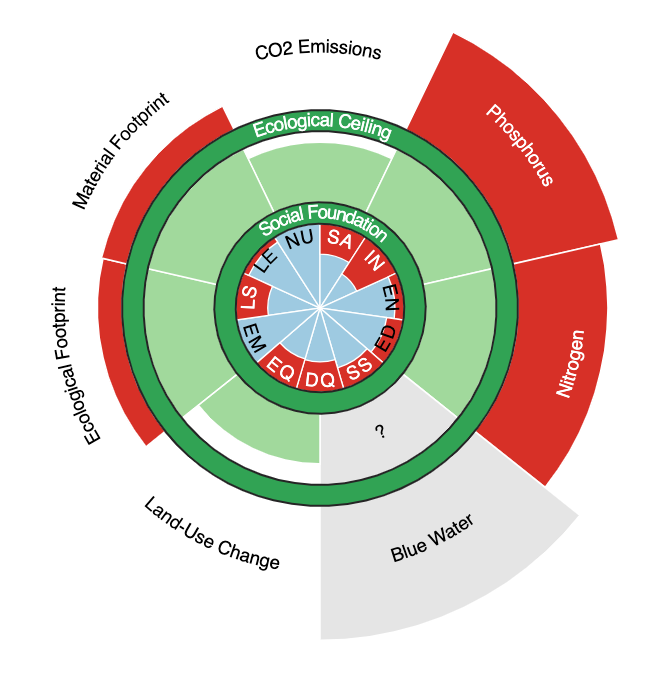
The Global South is rightly pursuing the same well-trodden path of development as high-income nations. And if they follow the same fossil-fuelled, consumption-driven path as the north, living standards will rise, birth rates will fall, and ecological overshoot will accelerate.
We will have solved one crisis only to make the ecological one catastrophically worse.
A development crisis
The population crisis is, at its core, a development crisis. The problem isn’t that there are too many people. The problem is that we have only one model for meeting human needs — economic growth — and it cannot do so without creating ecological overshoot and demographic destabilisation.
Before the Industrial Revolution, human societies lived within ecological limits — not by design, but by necessity. What the revolution unlocked was the ability to continuously expand production. That ability spawned the assumption that growth is the natural and inevitable path to human progress.
That assumption has become the obstacle to human progress.
Solving the development crisis involves rejecting economic growth as the foundation of all economic and social activity and shifting to a post-growth economy.
The solution
The central idea of post-growth is to replace the goal of increasing GDP with the goal of improving human wellbeing within planetary boundaries. This could be achieved by:
- Reimagining social success — shifting the measure of progress away from GDP growth and wealth accumulation toward wellbeing, sufficiency, and non-material sources of meaning.
- Introducing resource caps — introducing diminishing limits on the throughput of materials and energy, using ecological footprints to determine each country’s “drawing rights.”
- Embracing circularity — incentivising a shift from a linear to a circular economy where products are designed to be reused, repaired and recycled rather than disposed of.
- Reducing working hours — as productivity increases and AI replaces labour, work is shared across the workforce rather than creating unemployment, moving toward something closer to the 15-hour week envisioned by John Maynard Keynes.
- Introducing a Universal Basic Income — a no-strings monthly payment to every adult citizen, funded partly through a maximum income policy, helping to redistribute wealth.
- Introducing a maximum income — a cap on individual earnings through progressive taxation, culminating in a 100% tax rate above an upper earnings threshold, preventing the concentration of wealth that growth economics produces.
- Wealth redistribution — illegalising tax havens, introducing wealth taxes, wealth caps, and inheritance taxes of 90% or more to ensure poverty is addressed through redistribution rather than further growth.
- A shift in values — from competition to cooperation, from consumerism to sufficiency, from individualism to collectivism, and from humans as controllers of nature to humans as guardians of it.
None of this is simple; in fact, it would require a fundamental rewiring and total transformation of modern society. But the alternative, continuing to pursue growth as the solution to the problems it creates, is not a strategy; it’s a trap. And the demographic and ecological data suggest we are running out of time to find a way out of it.