

The real crisis isn’t environmental — it’s that we don’t know how to meet human needs without breaking the planet.
We like to think of sustainability as a technical challenge — we need governments to implement better policies, tech companies to develop greener technologies, and individuals to make better choices. Essentially, we need to make small tweaks to the system, and we’ll achieve sustainability.
If only life were that easy.
Industrial society has flourished by extracting more and more from the Earth. But the richer we become, the more damage we do. We’ve become great at internalising the benefits — higher living standards — while externalising the costs —environmental destruction.
The cold, hard truth is that we have no idea how to build a society that meets human needs within the planet’s limits. No blueprint exists. And even if it did, our political, economic and cultural systems aren’t capable of delivering it.
We talk about a just transition, about ending poverty, about green growth and mindful consumption. They’re words with no substance.
Achieving sustainability is, by far, the most difficult challenge humanity has ever faced. Why? Let’s begin by trying to picture what a sustainable society might look like.
The Doughnut — destination sustainability
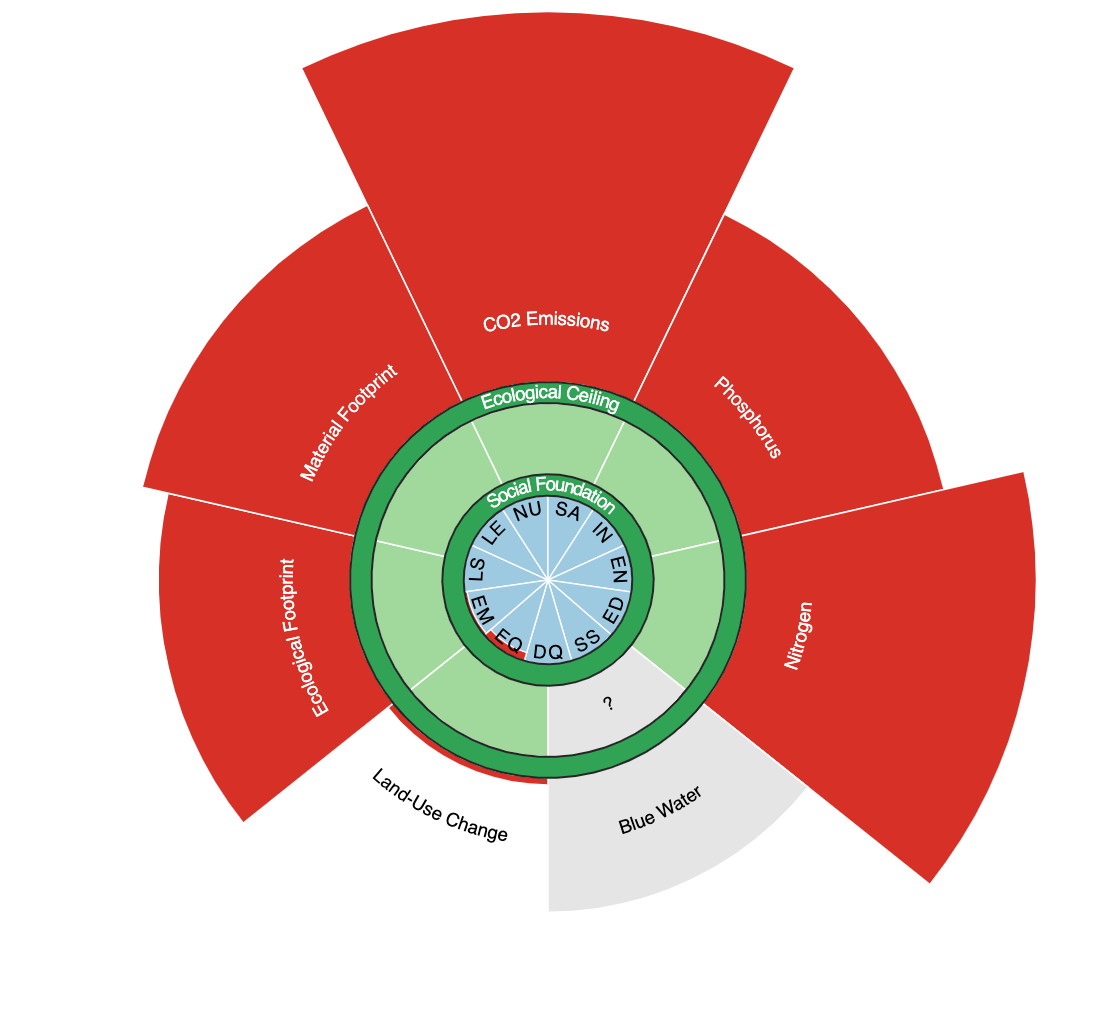
Kate Raworth’s Doughnut Economics provides the clearest picture of a sustainable society. The model combines two sets of boundaries. The inner boundary is the social foundation people need to live a fulfilling life. Below that foundation are shortfalls, whereby people don’t have access to these essentials — such as food, water, energy, education, housing, healthcare, etc.

The outer ring of the Doughnut comprises nine planetary boundaries. These are ecological limits that are essential to maintaining the current environmental conditions.
The more pressure we place on a boundary — for example, by increasing carbon emissions, which leads to climate change, or by converting land for agriculture, which leads to land conversion, or through deforestation, which leads to biodiversity loss — the greater the risk that it breaches the ecological ceiling.
Breaching the ecological ceiling leads to overshoot. The further a boundary overshoots the safe space, the greater the chance it transforms the environment into a new, unknown state.
Between the boundaries is a safe and just space — the doughnut itself — where human needs are met within planetary limits. All sounds simple enough in theory, but the enormity of the challenge at hand becomes clear when assessing our current reality.
Rich countries overshoot
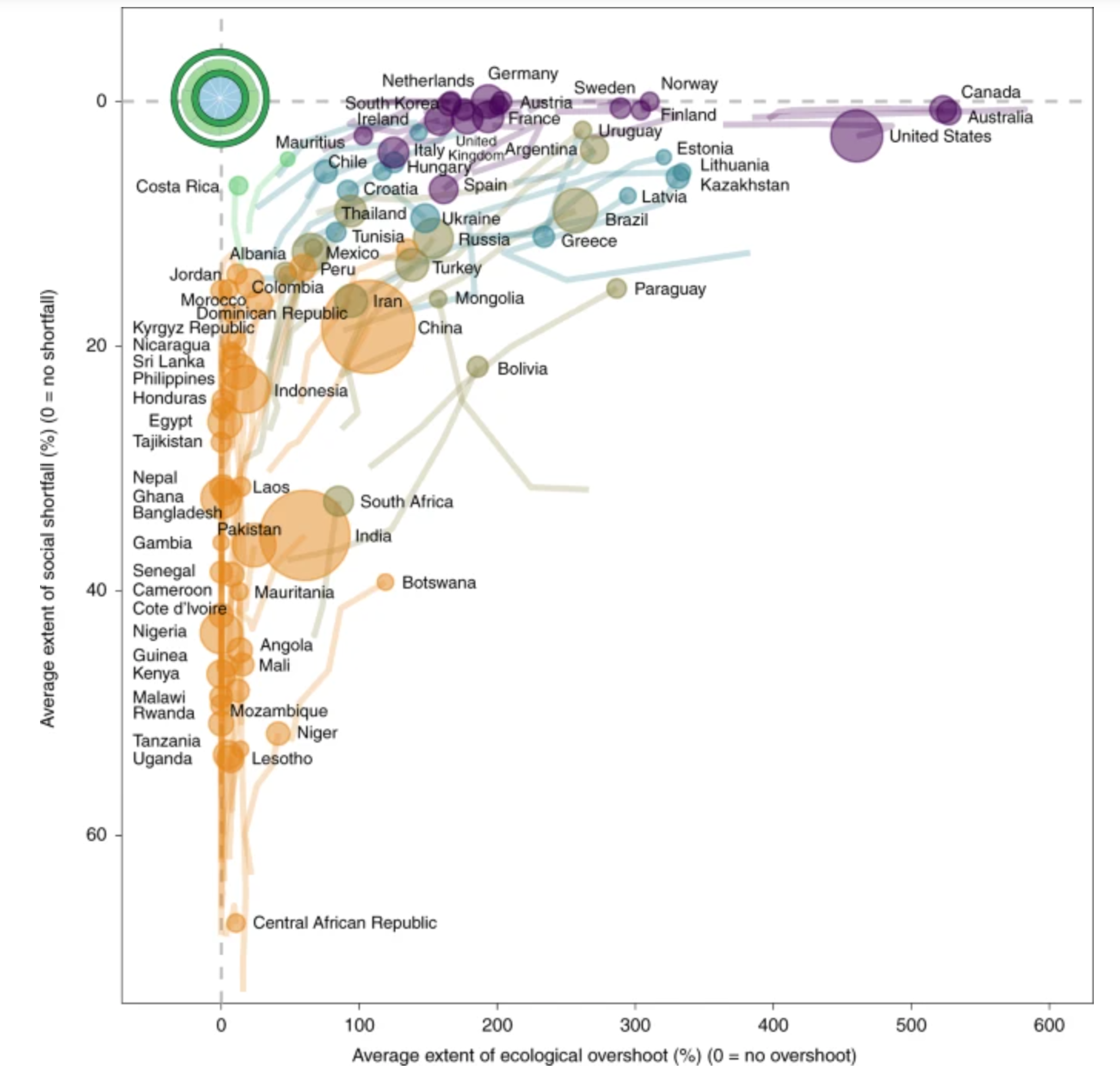
The Global Inequality Project shows how in the global north — countries like the US, Canada, UK, Germany, France and Japan — have achieved high living standards.
On the inside of the doughnut, they’re close to meeting every social foundation. On the outside, they are ecological disasters.
All of the planetary boundaries are being breached because high living standards are fuelled by consumption. The argument has always been that the more someone consumes, the happier they’ll be. The problem is that the more we consume, the greater our environmental impact.
Rich nations may look relatively successful socially, but they are structurally unsustainable.
Poor countries fail to meet needs — but still overshoot
In the global south, countries like India, Indonesia, and Nigeria sit well below ecological thresholds in many areas. Their citizens consume far less — but also fall short on nearly every social indicator. On the inside of the doughnut, there are massive gaps in health, education, income, infrastructure, and security.
Worse, even these lower-income countries often overshoot multiple environmental boundaries. In other words, they don’t meet needs and still degrade ecosystems.

The global south is home to billions of people whose needs are not being met. Rightly, these countries are pursuing the same development as the global north. But if they follow that path — fossil-fuelled industrialisation, mass consumption, carbon-intensive lifestyles, meat-heavy diets — the result will be catastrophic.
The social development paradox
The crisis we’re facing is wrapped up in a paradox. Our current approach to social development creates a ‘just’ space. But by doing so, it creates a dangerously unsafe environment.
By raising living standards now, we undermine future generations’ ability to maintain them — because we’re destroying the environment they need to survive, let alone thrive.
The challenge we face looks even worse when broken down by country. Not one country is meeting human needs within planetary boundaries. Not one country is living sustainably.
Not one.
Countries like Sweden and Finland often top sustainability metrics. But they overshoot planetary limits by huge margins. While they appear ‘green’, the very high living standards enjoyed in the Nordics are the result of importing goods and services and outsourcing the environmental harm to the poorer nations that produce them. It’s the same model followed by all countries in the global north — internalise the social benefits, externalise the environmental costs.
What’s needed is a different development model. But no such model exists. We simply don’t know whether theory can translate into practice when it comes to a sustainable development path because we’ve never tried.
The scale of the changes we need to make suggests that what’s needed is a transformation of our political, economic and cultural systems. But you can’t just transform highly entrenched, complex systems. Meaning the systems causing the crisis are the same ones we expect to solve it.
How is that possible?
A global strategy
The short answer is, it’s not. The longer answer is that achieving sustainability requires high-income nations to dramatically reduce consumption. This will require a shift to a post-growth economy where production is organised to meet human needs and well-being within environmental limits, rather than being focused on never-ending expansion and exploitation to achieve increasing incomes.

Poorer countries need to achieve the social foundations by increasing resource use — they need to consume more to raise living standards. The aim would be that the two meet somewhere in the middle, where the Doughnut is achieved on a global scale.
The only way such a state of affairs could be achieved is through intense collaboration and cooperation between countries around an agreed strategy. Aside from intense geopolitical rivalry, which makes global coordination impossible, nations are independent of one another.
Who then would manage this strategy?
You suspect some kind of global government, which we don’t have. Management goes hand in hand with planning. A planned economy is the enemy of free markets. It screams socialism, which many associate with pure evil.
Do you think the rich elite will voluntarily accept the need to centrally plan the economy when their power and wealth lie in free markets?
And even if nations agree to such a strategy, how would that governance structure ensure that each country cooperates and takes the necessary steps to move towards the Doughnut?
What arguments would be used to achieve it?
Sure, it’s a moral imperative for every person to have a certain standard of living, but when has this not been the case? It is unrealistic that we would achieve a level of cooperation unseen in the course of human history.
To make things worse, how exactly would high-income nations sell this vision of sustainability to citizens?
They may argue that we’re doing this for the good of the environment and humanity. But when has any government looked beyond its borders? People are self-serving, as are governments. No government will embrace a strategy that openly demands sacrifice — especially not for the benefit of people in other countries.
And why would the global north want the global south to develop? Wouldn’t that place more competition on resources? Worse, wouldn’t it place more competition on the high living standards enjoyed in the north?
By design or disaster
Now, there is an argument that we don’t have a choice. And that is true. We must implement a radical redesign of society that moves us towards the Doughnut. But while the Doughnut looks and sounds great, in practice, it’s unclear how it can ever be achieved through incremental reform.
It’s pure fantasy to imagine humanity is going to have a collective epiphany where we all start working together for the common good. What reinforces the unlikelihood that we will avoid disaster and plan our way to a sustainable future is that there appears to be no need for such a radical approach.
The end simply does not justify the means because the risk of environmental change remains just that, risks. They are not impacting the global economy in a discernible way that impacts economic growth. And so long as growth is maintained, the global economy will appear ‘healthy’.
The critical point here is that societies don’t change unless they are forced to change. We know that the pressure we’re placing on planetary boundaries means it is a matter of when, not if, we are faced with devastating environmental changes that will make it harder and harder to maintain economic growth.
No growth, and within a few years, the global economy collapses. War and a total breakdown of cooperation in the market will quickly follow in its wake as countries fight over scarce resources in a desperate attempt to retain a semblance of normality.
We need a total rewiring of society around sustainable principles. When you consider the monumental scale of the changes we need to make, collapse isn’t necessarily a bad thing. Collapse is precisely what’s now needed to achieve sustainability, because collapse will create the conditions where the redesign of our political, economic and cultural systems becomes possible. Will we succeed when collapse presents the conditions for rewiring? No one knows. But the future of humanity depends on trying.

Dear Paul,
Thank you very much for your interesting and refreshing article, which addresses fundamental issues in our contemporary world. One of the reasons, it caught my attention is its overlap with the issues I address in my life’s work “Quest to Rescue Our Future” (Amsterdam 2016, Rescue Our Future Foundation, 555 p.) You can read the first chapters at https://www.rescueourfuture.org/quest, and if you like, I will send you a pdf copy by email.
Your diagnosis of our critical situation is spot on, a state of crisis that the Quest locates even deeper, as you can see in two of the shocking conclusions of the Quest.
1. Modern civilization has failed as a project for humanity and cannot offer any option for survival from within.
2. We need an extrasystemic solution, and the only remaining force that is up to the task is the moral reserves of humanity.
A recent opening article of a book published in the most densely forested country, “Sustainable humanity” https://crscenter.com/sustain.pdf, explains why the path of sustainable development (e.g., clean energy for dirty system) is part of the system maintenance narrative that is the reason why we have been losing the struggle for our environment and peace for half a century. We have been looking for a needle in the wrong haystack!
The problem is not so much that “we don’t know how to meet human needs without breaking the planet”, but that we break the planet because we have substituted needs satisfaction (of the majority) by profit maximization of small elites (the real problem is profiteerism, not ‘consumerism’ which it fabricates).
My apologies for these cryptic remarks. You can see the whole argument in the book or in the compilation of brief statements “Action is the best prediction” https://crscenter.com/reflections.pdf
Feel free to reach out.
Glenn