
With the greatest sleight of hand in modern history, the true cause of the climate crisis was rebranded as its solution — and billionaires cashed in
For decades, we’ve been told the climate crisis is caused by emissions. But this is only a half-truth. Emissions are the symptom; the cause is economic growth. That truth has been buried behind an elaborate story enabling billionaires to profit while humanity accelerates towards collapse.
The link between growth and emissions isn’t a radical idea. The evidence is overwhelming. The truth is staring us in the face, yet the connection between growth and the climate crisis has been intentionally buried through smoke and mirrors.
If this lie is sealing the fate of humanity, why is it being told?
Because growth is the foundational law of capitalism. The first commandment, if you will. Growth leads to more wealth, which should create higher living standards. We have all seen the effects when growth stalls: it creates chaos.
And yet, when the economy does grow, the benefits aren’t noticeable.
In the midst of a cost-of-living crisis, it certainly doesn’t feel like the global middle class is benefiting from growth.
With nearly half of the world’s population living on less than $5.50 a day, the global poor certainly aren’t benefiting. Actually, it’s argued that growth is the only way to lift the global poor out of poverty. It sounds perfectly logical: if growth raised living standards in the past, then surely more growth will do the same now?
The evidence says otherwise. For the last thirty years, the bottom 50% has consistently held around 2% of global wealth.
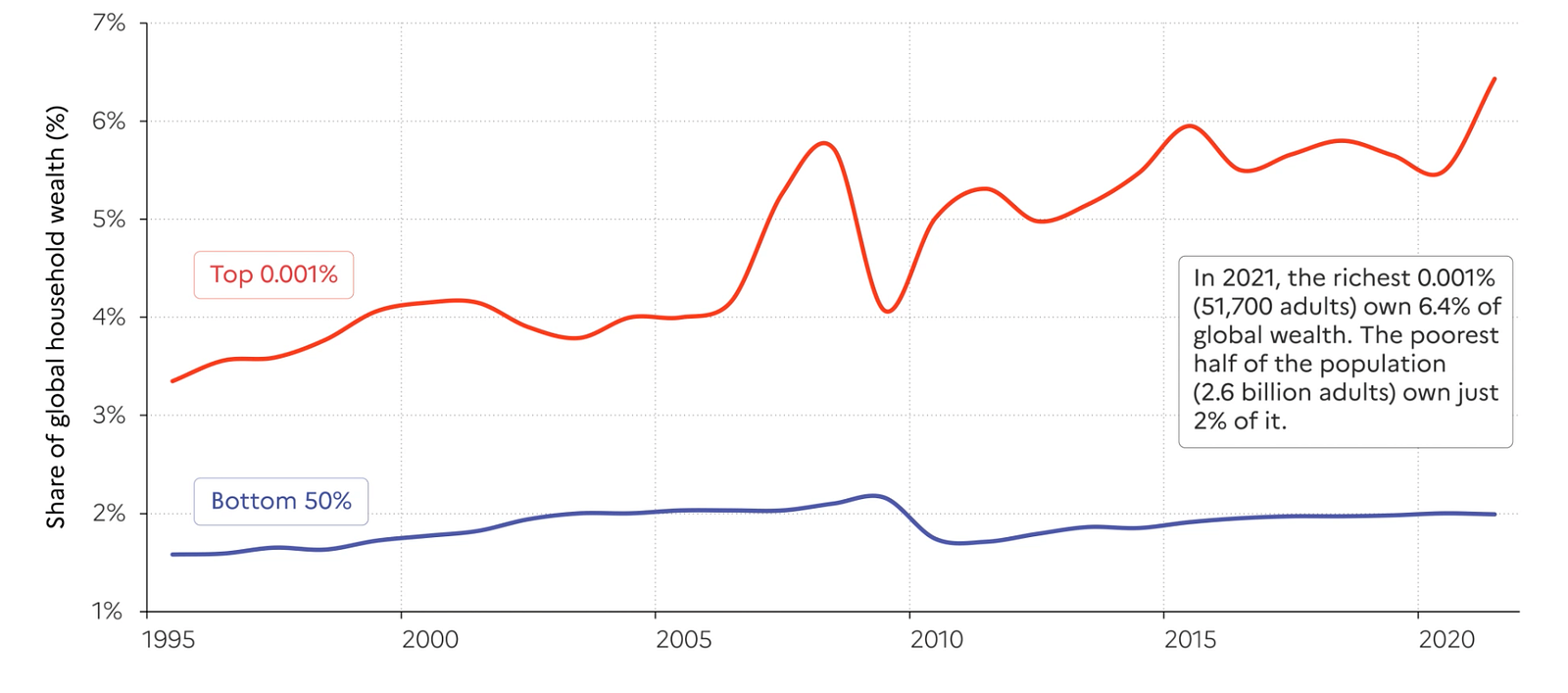
The only group benefiting from endless economic growth is the richest people on Earth. Since 1995, their wealth has grown at two to three times the rate of average wealth. Billionaires’ share of global wealth has tripled. The number of billionaires has exploded from 366 to 3,028.
We don’t need more wealth; we need better mechanisms to distribute it to ensure the needs of all are met within planetary limits. We need to stop the blind, mad pursuit of growth to inflate the fortunes of the rich, and we need to halt carbon emissions, right now.
But billionaires don’t care about emissions. They certainly don’t care about ending global poverty.
They only care about making more money.
An attitude typified by Elon Musk, not content with being the richest man in the world, he has his sights set on increasing his fortune to $1 trillion. For that to happen, Tesla’s valuation has to hit $8.5 trillion.
Hitting that valuation would require levels of production, energy use, and resource extraction that make a mockery of the idea of the ‘green’ transition Tesla claims to be spearheading.

The need to reduce emissions has become urgent, and all we’re doing is putting our proverbial foot down on the accelerator so a handful of billionaires can make more billions. But fear not, the billionaires are already building luxury bunkers for themselves, prepping for a future of collapse they’re actively causing. Meanwhile, everyone else will be fighting for their lives.
What. Is. Going. On.
How are they getting away with it? There are three steps to the elaborate story.
Step 1: Get experts to focus on the effect
The first is to take advantage of experts in institutions like the UNFCCC, which exists to support countries in setting ambitious targets to reduce emissions.
But its effectiveness is questionable, at best. Take the COP, which the UNFCCC has organised annually for the last 30 years. It exists to support countries in agreeing to take tangible action to reduce emissions.
It also creates a stage designed to reinforce the argument that decreasing emissions will reduce the worst impacts of global warming, helping us to avoid a catastrophic future. Governments, institutions, and industry have all jumped on this bandwagon.
What makes this argument so clever is that it’s a perfect half-truth. Carbon emissions are causing global warming; reducing the cause will reduce the effect, surely.
It’s a fair assumption to make, but it’s an entirely wrong one, reinforced by the fact that the strategy isn’t working.
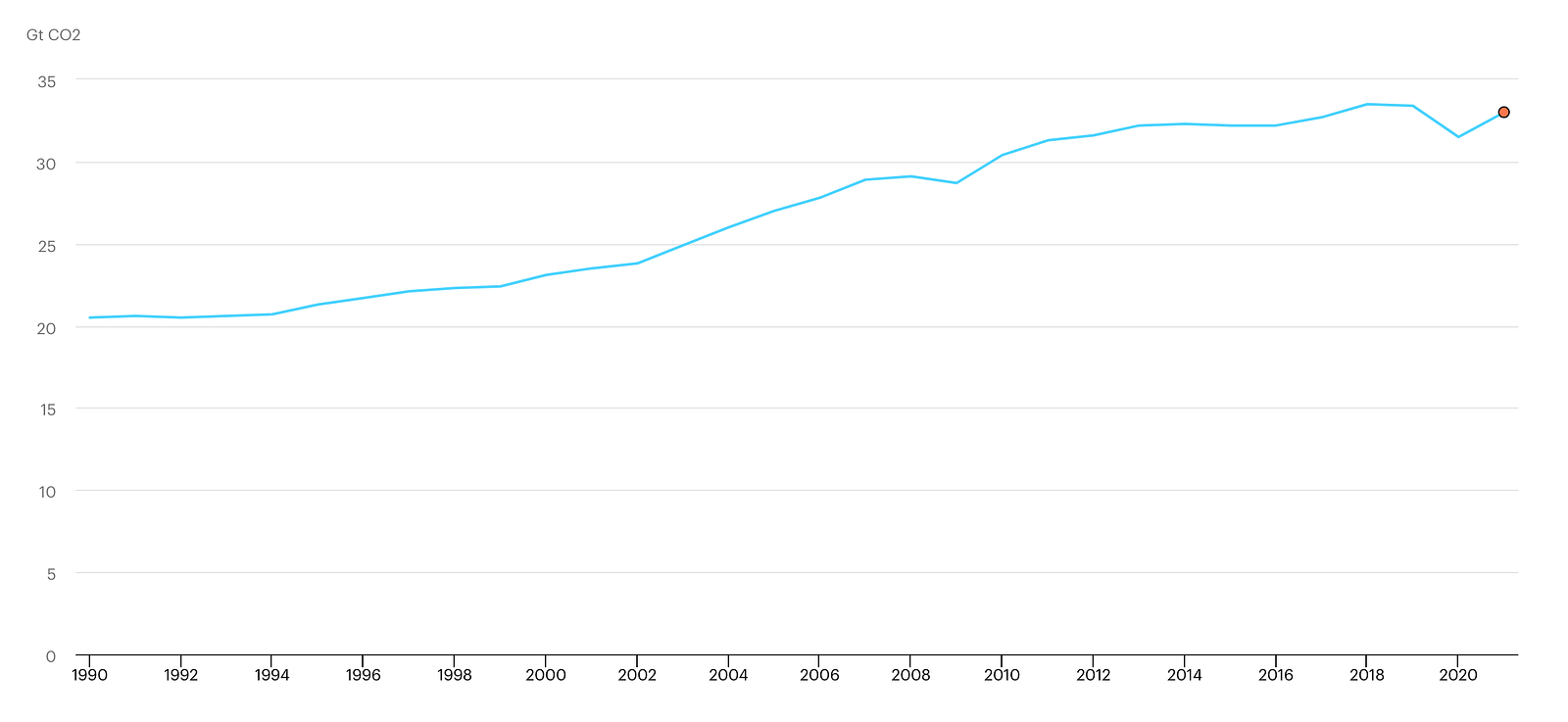
In 1995, when COP1 met, global CO2 emissions were 21.3 billion tonnes. By 2015, the year of the Paris Agreement, they had risen to 32 billion tonnes. By 2024, they hit 37.8 billion tonnes — the highest ever recorded.
But herein lies the genius behind focusing on emissions: we may be failing, but we are trying. What more could we possibly do?
Step 2: Omit critical facts
The next step is to hide the underlying reason for emissions.
The reason emissions continue rising is simple: achieving economic growth requires increasing production. To increase production, you need to increase energy inputs — and seeing as 80% of total energy supply is derived from fossil fuels, inevitably, the greater your energy needs, the higher the total emissions.
The UNFCCC has never, and will never, connect the cause (economic growth) with the effect (increasing emissions). Not because it’s overtly lying but because it willingly omits the single most important fact about the climate crisis.
It’s a clever sleight of hand that deflects away from the underlying problem. But step 3 is where the deception becomes genius.
Step 3: Rebrand the cause as the solution
The cause of the problem has been rebranded as the ultimate solution to it.
The UNFCCC and other global institutions bang on about ‘sustainable’ growth, or ‘green’ growth.
The thinking is that technological efficiencies can decouple emissions from growth. And there are stats that support this argument.
Global GDP rose from $31 trillion in 1995 to $111 trillion in 2024, a 360% increase.
In that time, CO2 emissions rose from 21.3 billion tonnes to 37.8 billion tonnes, a 178% increase.
You might be thinking that’s terrible news, but it’s viewed with optimism because emissions are rising more slowly than GDP. Many rich nations are seeing the benefits of growth increasing while emissions decrease; at face value, the strategy appears to be working.
But again, the rosy picture is a smokescreen.
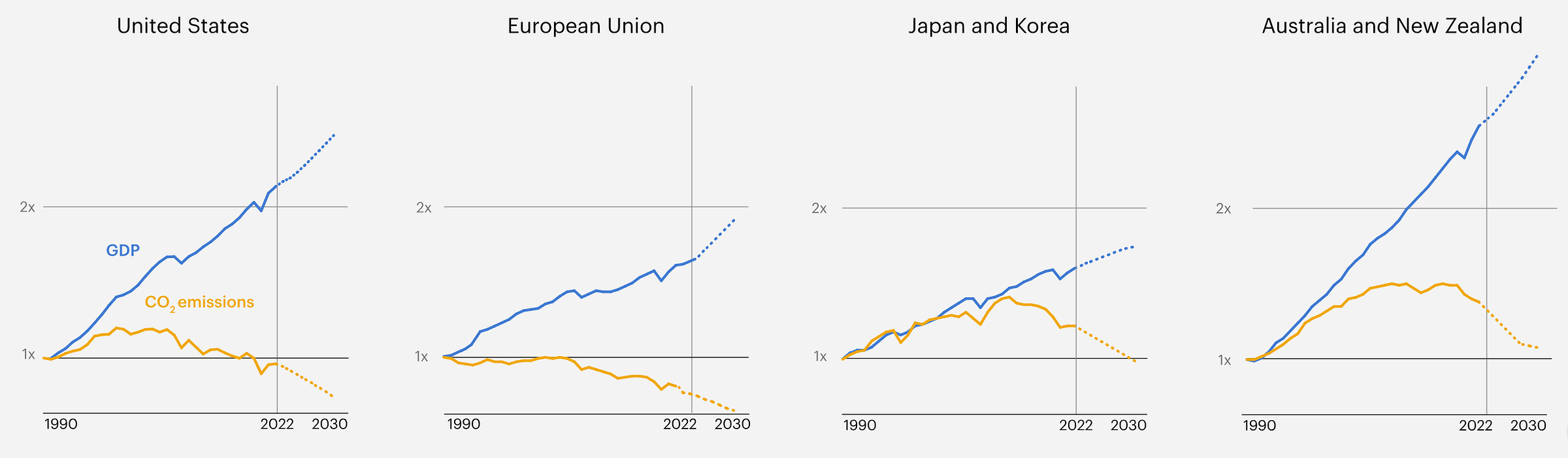
What’s actually happened is that rich nations have outsourced production, and the associated emissions, to poorer nations. Now they import goods, but continue to outsource the emissions.
This ‘decoupling’ is nothing more than creative accounting.
Those products wouldn’t be manufactured if it weren’t for demand from rich nations, so how can it be argued that the emissions should remain at the point of production rather than the point of consumption?
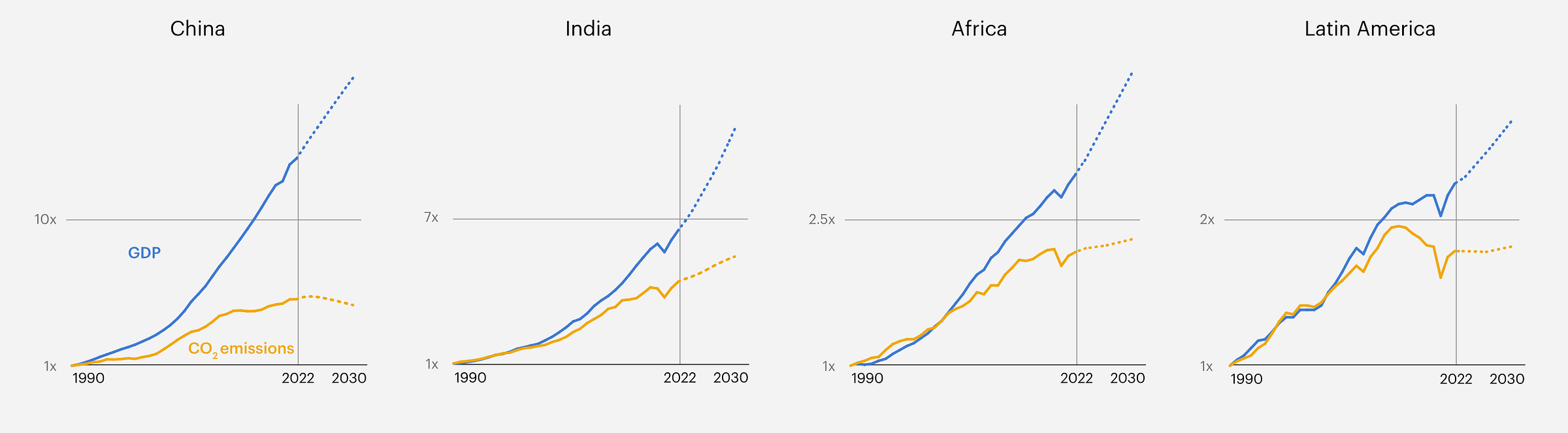
The reality is that the same emissions are just coming from different places. Emissions in poor nations are increasing because they produce the goods that are now sold in rich nations.
Viewing any country in isolation distorts the picture. But it’s irrelevant because the climate doesn’t have borders. The only stat that matters is the one that shows total emissions. Unsurprisingly, global emissions in 2025 are estimated to hit 38.1 billion, which will be a new record.
The road to collapse
Rather than confront the economic model driving the crisis, governments, institutions, and industry built an alternative narrative — one that blames emissions while protecting the engine of growth that produces them.
What would have been a systemic structural problem has become a technical one. The solution isn’t systems change; it’s innovation, green tech and sustainable growth.
In that framing, the greatest sleight of hand in modern history was born: the cause of the crisis was rebranded as the solution to it.
The smokescreen has worked for decades, but we can’t continue increasing emissions without consequences. Inevitably, we are going to face devastating impacts that risk social collapse.
The only chance humanity has of avoiding collapse is by rejecting economic growth as the organising principle of society and embracing degrowth. We need a wealth tax, a maximum income, and a universal basic income. We need a system built around meeting human needs within ecological boundaries, not expanding the wealth of billionaires.
Collapse will create incomprehensible suffering; even billionaires fear it above all else because it will destroy the system that makes them so rich. That’s why they’re building bunkers.
Avoiding such a fate is unlikely without a collective awakening from the people benefiting most from the status quo. But the rich elite have no intention of letting go. They are drunk on greed, mad with power, and perfectly content to gamble the future of humanity for a few more decades of obscene wealth.
As bleak as the future looks, collapse has now become necessary to overcome the systemic causes of the climate crisis by creating the conditions where the redesign of society around sustainable principles becomes possible. While the future remains uncertain, what’s almost guaranteed is that the age of the billionaire will end. We have the power to decide what replaces it.