

The great American success story is built on a broken society
We’re No.1, baby! The land of the free. The home of the brave. A place where dreams become reality. For generations, America has sold itself as the greatest country on Earth. And there’s a statistic that seems to prove it: since 1890 — for the last 135 years — America has had the largest economy in the world. It’s an achievement that makes the strongest possible case that the American social experiment has worked.
That experiment began in 1776, when America gained independence. At its core, America was a nation forged in the fire of capitalism, shaped by a system that tied individual freedom to the free market. Classical liberalism, the ideology of the time, promised that anyone willing to work hard could prosper: the government would step back, the free market would take centre stage, and success or failure would rest squarely on the individual.

The idea was that it would create a true meritocracy where effort determined reward, and every citizen could rise on their own merits.
These ideas may be fairly unremarkable now, but in 1776, they were radical. In Europe, they were revolutionary. The entire world has since embraced capitalism, but what makes America unique is that the rise of capitalism coincided with the country’s formation. Capitalism left indelible marks, forging not only its economy, but its very soul, identity, and culture.
It’s that indelible imprint, that spirit — the can-do attitude, the business savvy, the drive to stay ahead — that many argue sets America apart.
The Success Story
If capitalism is a game, America plays it way better than anyone else.
Corporate dominance: The U.S. is home to 58 of the world’s richest companies, commanding a market capitalisation of over $31 trillion — 73% of the total value of the global top 100.
Extreme wealth: No surprise that massive corporations help produce extreme wealth. America is home to more billionaires (905 out of the world’s 3,028), more centimillionaires (individuals with $100 million+), and more millionaires (23 million millionaires) than any other country.
Educational prestige: The U.S. dominates global rankings of universities, with more institutions in the world’s top 100 than any other country.
Cultural influence: From Hollywood to Silicon Valley, America exports not just products, but dreams.
Sporting success: On the world’s biggest stage, America has won over 1,000 Summer Olympic gold medals — more than any other nation in history.
If wealth and prestige are the scoreboard, America is in a league of its own.
The Human Cost
But wealth is not the only scorecard of success. When you measure success on a social level, America is losing badly.
Inequality: America has extreme levels of wealth inequality. According to the Federal Reserve, the richest 1% of Americans — just 3.4 million people — own 31% of all wealth. The bottom 50% — around 170 million people — own just 2.6%.

Healthcare: Wealth inequality helps explain why, as of 2025, around 26 million Americans (8% of the population) live without health insurance, often because they can’t afford it. Illness can mean bankruptcy.
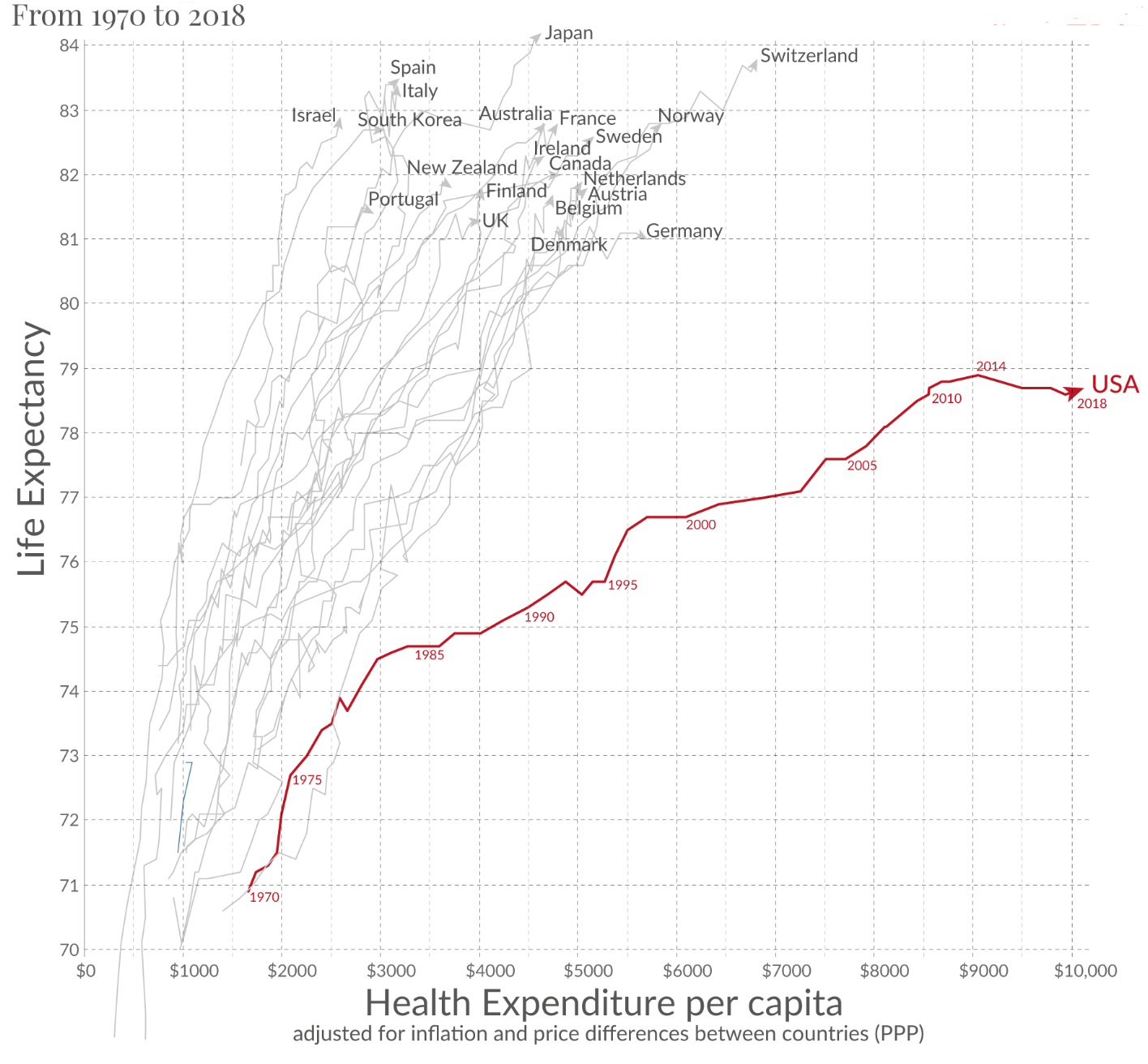
Highest healthcare spend, lowest life expectancy: In 2021, the average annual cost of health insurance was $7,739 for an individual and $22,221 for a family. This excludes government spending, which, at $12,555 per person (as of 2022), is the highest of all Organisation for Economic Co-operation and Development (OECD) countries. America may spend the most on healthcare, but at 78, America has the lowest life expectancy of high-income nations.
Drugs: America consumes more illegal drugs than any other country and is in the grip of an opioid crisis, declared a public health emergency back in 2017. From 1999 to 2023, around 806,000 Americans died from opioid overdoses.
Guns and violence: America has an estimated 393 million civilian-owned firearms — more than one per person. It also has more mass shootings than any other country.
Incarceration: With around 1.8 million people behind bars, the U.S. has the highest prison population in the world. The “land of the free” is also the land of mass incarceration.

Education: America charges the highest tuition fees in the world. Unlike most countries, universities have significant freedom to set tuition fees. Student debt now stands at over $1.8 trillion, weighing down entire generations.
Employment rights: Trade Unions, which exist to protect the interests of ordinary Americans, have been hollowed out, leaving employees at the whim of employers. That America prioritises the rights of businesses over its employees explains why it is the only high-income nation without statutory paid leave. Employees are forced to negotiate terms.

Trust and community: Surveys consistently show Americans have declining trust in government, media, and even one another. Social bonds have frayed to the point where loneliness and mental health crises are at epidemic levels.
The belief that broke America
Capitalism’s cheerleaders argue that inequality is the price of individual freedom. That markets create endless opportunities, and those who succeed deserve their riches. If you fail, it’s your fault. If you’re struggling to make ends meet, you need to work harder, hustle smarter, climb faster — the opportunity to better yourself is always there.
It’s a seductive myth: 60% of Americans believe they could become billionaires, even though fewer than a thousand actually exist.
Hope keeps the system alive. But the reality is stark: most people aren’t competing on equal ground.
Healthcare, education, housing, even basic safety — in America, they all depend on wealth. If you’re rich, the system works beautifully. If you’re not, it fails you at every corner.
A social experiment gone wrong
Capitalism has made America exceptional — but not in the way its founders intended. Social failure is baked in, a design flaw from a nation forged to serve a wealthy few rather than society as a whole.
America excels at creating millionaires and billionaires — but fails spectacularly at protecting ordinary citizens and distributing wealth fairly.
The richest country in human history also leads the world in poverty, addiction, gun violence, mass incarceration, and untreated illness. This is not success — it is systemic dysfunction.
America’s GDP may be enormous, but wealth is finite. A tiny minority thrives in luxury while the majority bears the cost — a system rigged to reward a few at everyone else’s expense.
The American social experiment matters because America’s apparent success has now become the global model. Developing countries are told to liberalise their markets, cut back the state, and let capitalism work its magic. Western allies follow America’s lead, from deregulated finance to privatised healthcare.
Capitalism in America has created prosperity for a minority at the expense of the majority. It has hollowed out communities, stripped social bonds, and reduced citizens to isolated consumers competing in a marketplace where the cards are stacked against them. This isn’t a success story. It’s a cautionary tale. America’s great social experiment has failed — and the world would be wise to stop mistaking it for success.